

2025 was another record year for the Baltic corporate bond market. Over the course of the year, local companies issued more than €4bn in debt securities, surpassing the previous record set in 2024. Of the more than 70 bond placements completed during the year, roughly two-thirds were accessible to retail investors.
Most Baltic corporate bonds are listed on the Nasdaq Baltic exchanges. While Vilnius leads in terms of market size — with the highest number of listed issues and the largest aggregate value — it ranks last in secondary market activity. Bonds listed in Vilnius accounted for just 9% of total turnover across the three exchanges and only 5% of all transactions. It seems that Lithuanian investors have yet to embrace secondary bond trading on exchange.
By contrast, Riga — a marginal player in equity trading — has emerged as the Baltic leader in secondary bond turnover. The Latvian exchange accounted for 61% of total corporate bond trading by value in 2025.
In attempting to foster exchange-based secondary bond trading, the Baltic exchanges are seeking to build something largely absent in developed bond markets such as western Europe or the US. In those markets, secondary trading in corporate debt overwhelmingly takes place over the counter, with investors transacting through dealers rather than on centralised exchanges. Whether the Baltic experiment in creating an active on-exchange bond market will succeed remains an open question.
More than 160 bonds worth over €4bn
In 2025, 161 corporate bond issues from 101 companies were listed across the three Baltic exchanges. Estonia’s Bigbank had the largest number of listed issues, with six outstanding bonds. Latvia’s Citadele bank and financial services group DelfinGroup each had five.
According to exchange data, the total market value of listed corporate bonds stood at €4.4bn at year-end. By comparison, the total market capitalisation of equities traded on Nasdaq Baltic was €11.3bn.
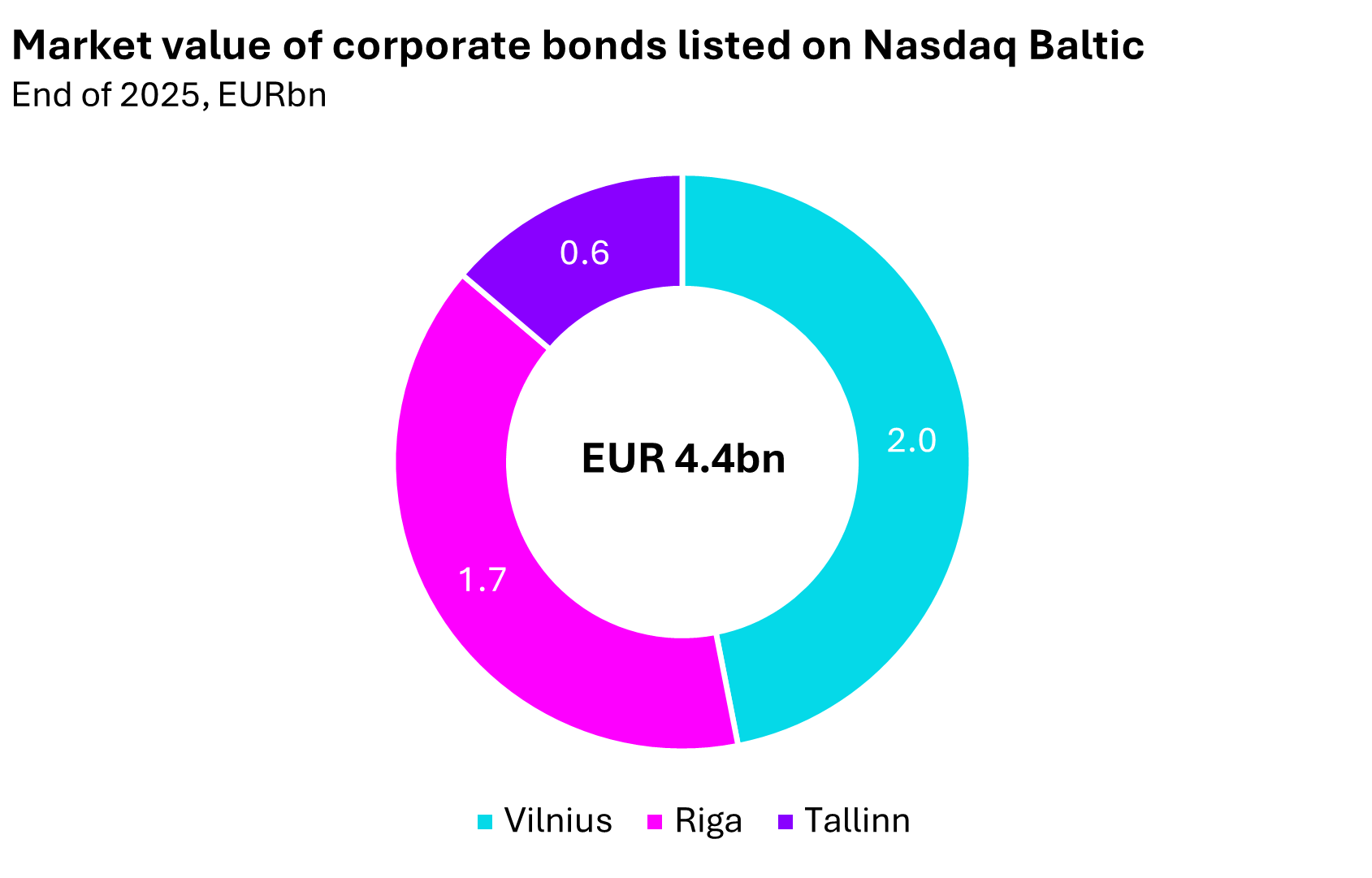
Vilnius was the largest exchange by both number and value of listed bonds. A total of 64 corporate bond issues were listed in Lithuania, with a combined value of €2.0bn at year-end. Riga hosted 58 issues worth €1.7bn, while Tallinn listed 39 bonds with a total value of €0.6bn.
Riga dominates secondary trading
Of the 161 listed issues, 45 did record a single on-exchange trade during the year. These included bonds from large and well-known issuers such as Ignitis, Maxima and Latvenergo. However, these issues were targeted exclusively at institutional investors and carried minimum investment thresholds of €100,000. Institutional investors typically trade bonds over the counter rather than on exchange.
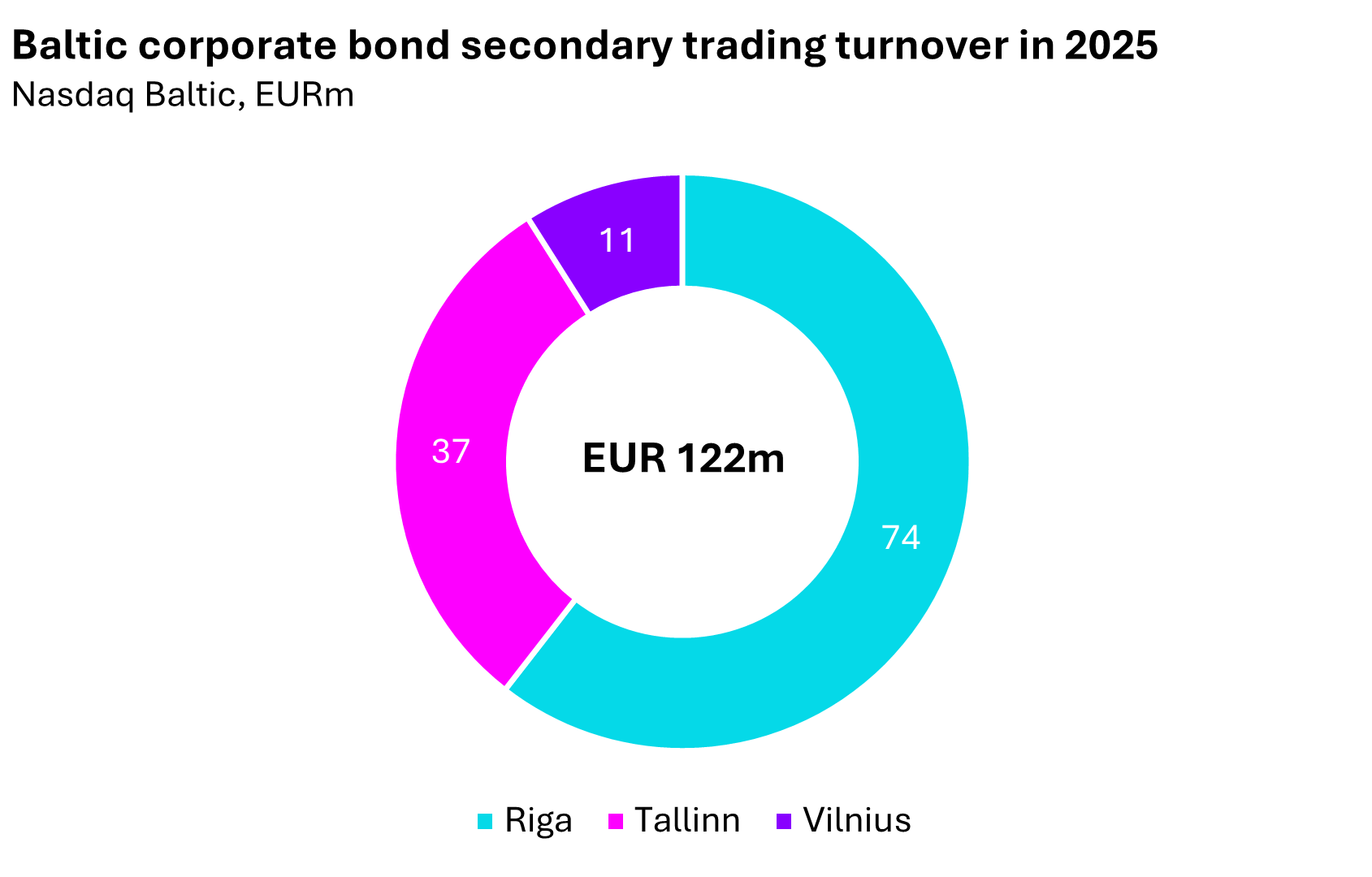
In total, more than 18 thousand bond transactions were executed on the Nasdaq Baltic secondary market in 2025, with an aggregate value of €122m.
Riga was the clear leader, generating €74m of turnover — 61 per cent of the Baltic total. Tallinn ranked second with €37m (3%), while Vilnius lagged with just €11m, or 9% of total turnover. Measured by number of transactions, Vilnius performed even more weakly, accounting for only 5% of all Nasdaq Baltic corporate bond trades. Given that domestic investors tend to dominate trading activity on their respective exchanges, the figures suggest that Lithuanian investors have yet to embrace exchange-based bond trading in meaningful numbers.
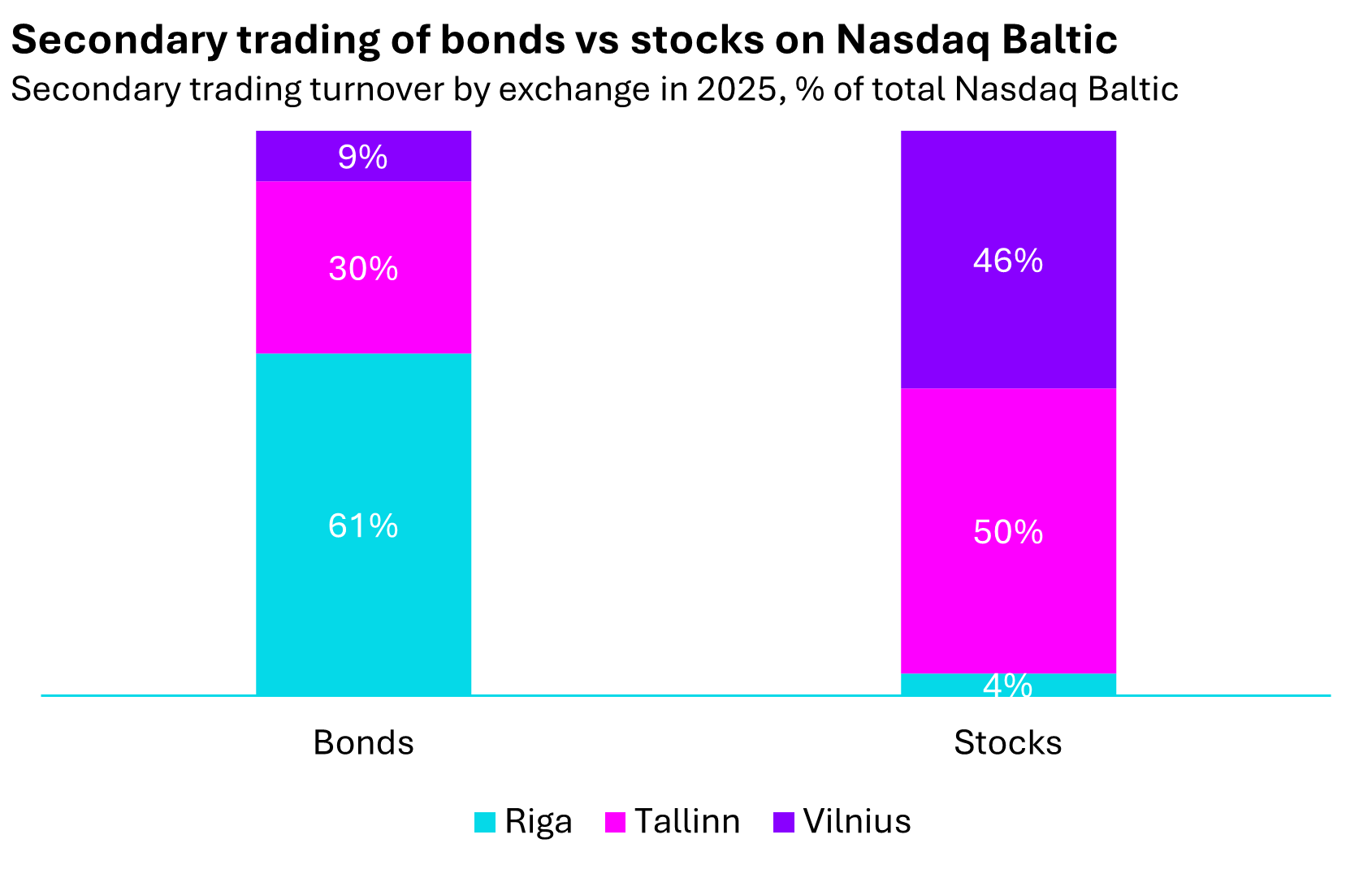
This stands in sharp contrast to equity trading. In the second half of 2025, Vilnius became the most active Baltic equity exchange, overtaking Tallinn, while Riga accounted for just 4% of total Nasdaq Baltic equity turnover.
Liquidity lags equities
The disparity in liquidity between bonds and equities is more than clear. In 2025, the three Baltic exchanges recorded 949 thousand equity trades with a combined value of €562m — 52 times more transactions and 4.6 times higher turnover than in bonds.
The difference is hardly surprising. Equity investors have effectively one route to exit their positions: selling on exchange. Bondholders, by contrast, have a defined redemption date at which their securities are repaid at maturity. As a result, secondary market liquidity is typically less critical for bond investors.
Most actively traded bond issuer: Citadele
The list of most actively traded bond issuers is dominated by Latvian and Estonian companies. Ranking issuers by on-exchange bond turnover, the first Lithuanian name appears only in 17th place: media group 15min, whose bonds generated €2.1m in turnover across 83 trades. Other Lithuanian issuers further down the ranking include Artea Bank in 24th place with €1.3m in turnover (266 trades), and Kvartalas, the developer of the Sąvaržėlė business centre, 26th place with €1.2m (43 trades).
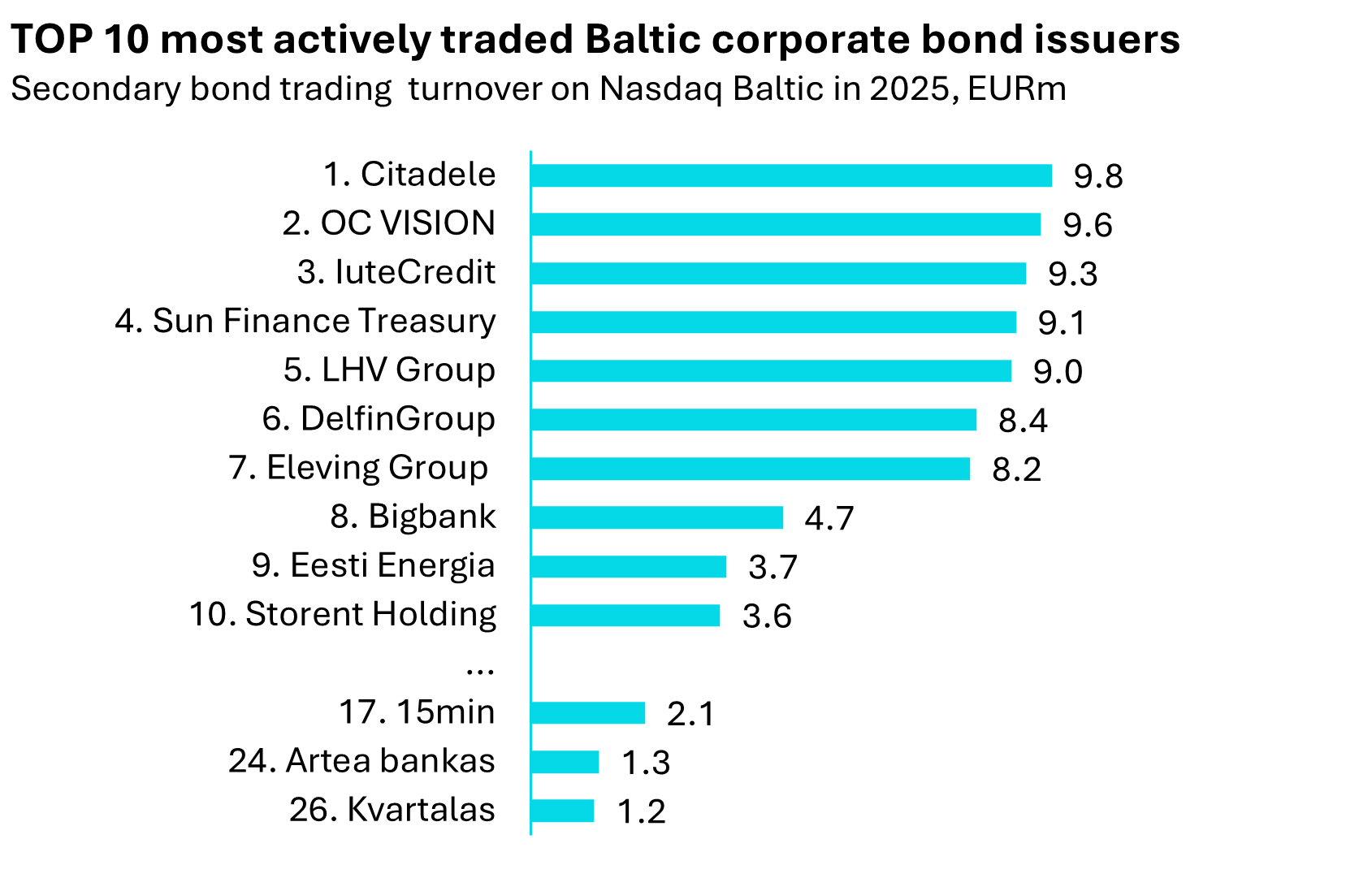
Among the ten most actively traded bond issuers, six list their bonds in Riga and four in Tallinn. Seven of the top ten operate in the financial sector, including banks and consumer lending businesses.
Citadele emerged as the most actively traded Baltic issuer, with bond turnover reaching €9.8m across 118 transactions. Notably, the Latvian bank secured the top position despite the fact that two of its five bond issues listed in Riga did not record a single trade during 2025.