Baltic equities did not post significant gains in the third quarter but still managed to edge ahead of foreign markets. The region’s main stock index, the OMX Baltic Benchmark, rose 2.9% over the quarter, reaching a new all-time high for the fourth consecutive quarter. Records are relatively rare on the Baltic stock market: it took more than four years for the previous peak, set in September 2021, to be surpassed at the end of 2025.
Over the past quarter, the S&P 500 returned 2.6% in EUR terms (or 2.0% in USD), while the STOXX Europe 600 fell 1.1%. The MSCI Emerging Markets index, which surged 25.5% in the second quarter on the back of a rally in South Korean and Taiwanese semiconductor stocks, was virtually flat, edging up just 0.2%.
Of the three Baltic exchanges, Riga was the strongest performer in the third quarter, with its index returning 7.4%. Tallinn followed with a gain of 6.2%. Lithuanian equities grew more slowly, with the OMX Vilnius rising 3.7%. The OMX Baltic Benchmark underperformed the individual exchange indices because it has a narrower focus on larger-cap companies, whose shares performed less well than those of smaller businesses over the quarter.
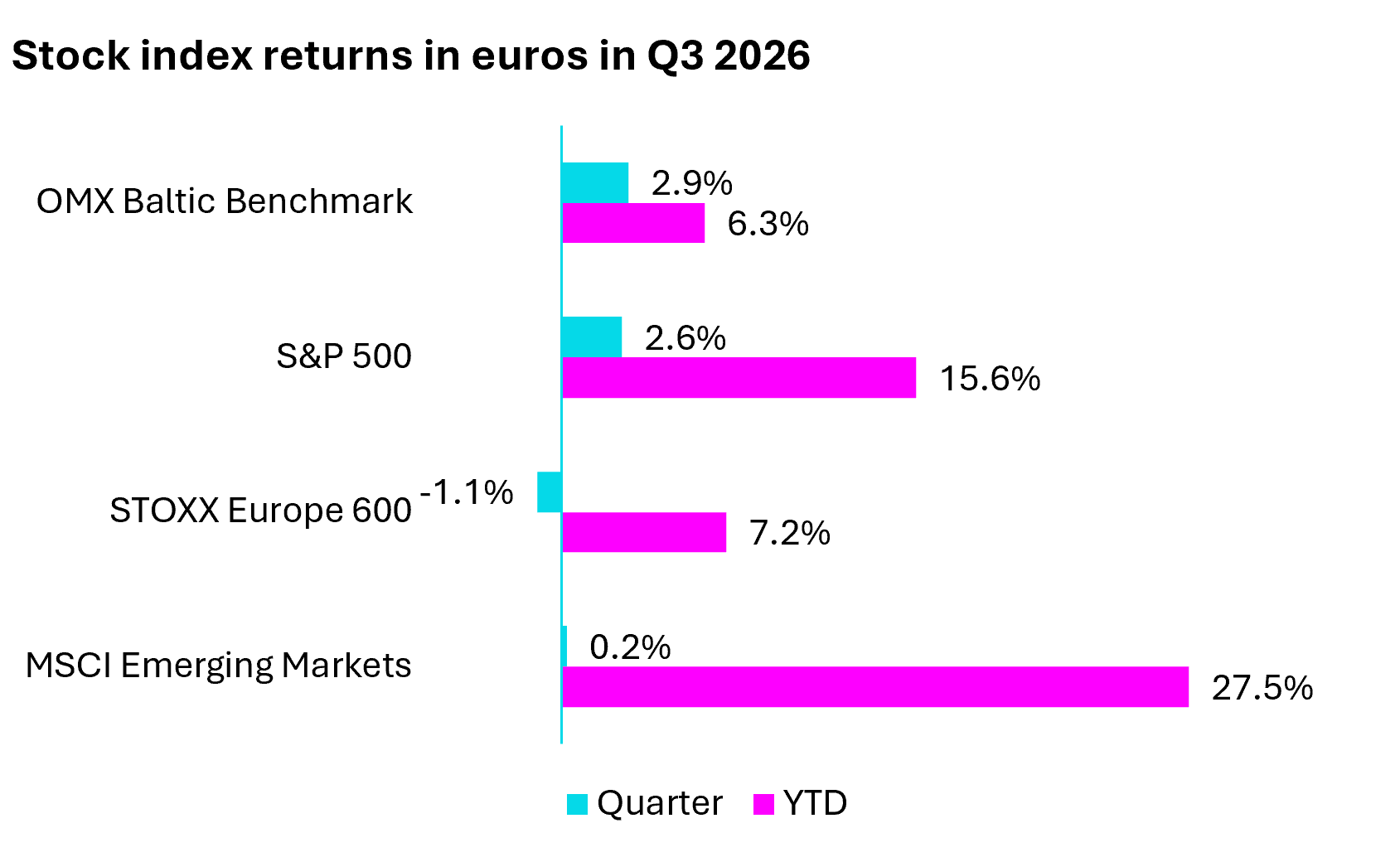
In the first nine months of the year, the Baltic equity index gained 6.3%, trailing foreign markets. Over the same period, the STOXX Europe 600 rose 7.2%, while the S&P 500 gained 15.6%. Driven by the rally in artificial intelligence-related stocks, the MSCI Emerging Markets index surged 27.5% year to date.
Baltic Core Property Fund IPO cancelled
In September, Baltic investors were offered an opportunity to participate in a new IPO. Lithuanian real estate fund manager Lords LB Asset Management sought to raise capital for its newly established Baltic Core Property Fund, with the fund units subsequently to be listed on the local stock exchange.
The initial offering was expected to raise up to EUR 35m to acquire the Artery business centre, located on Konstitucijos avenue in Vilnius, Lithuania’s equivalent of Wall Street. The building opened in 2024. Once additional capital had been raised, the fund planned to acquire K29, an office building opened in 2015 and located on the same Konstitucijos avenue. Both properties currently belong to other funds managed by Lords. The stated ambition was to raise a total of EUR 150m in equity for the newly established fund.
Both office buildings, particularly Artery, represent some of the best that the Lithuanian office market has to offer. They boast prime locations, high occupancy rates, quality tenants and modern construction, with K29 being only slightly older. Yet this was not enough to ensure a successful IPO.
The offering ran for almost a month, from 2 to 30 September. Once the subscription period ended, however, it was announced that the IPO was cancelled “due to insufficient investor demand”. Several factors may have contributed to this outcome: challenging conditions in Vilnius’s office rental market, the poor precedent set by Baltic Horizon, the fund’s legal structure (rather than a traditional joint-stock company), its fee structure, the rationale behind the IPO (a lack of foreign investors) and the relatively limited capital commitment from the management company (at over 5%), among other considerations.
An important point is that Lords is no newcomer to the local capital market. On the contrary, the firm is well known to most investors. Funds managed by Lords have successfully issued hundreds of millions of euros in bonds on local capital markets. The cancelled IPO nevertheless highlights the stark difference in Baltic investor sentiment towards debt and equity securities, and how difficult it is to translate success in the bond market into the equity market.
As international investors are no longer looking for acquisitions in the Baltic commercial real estate market amid geopolitical risks, a number of local real estate fund managers have potentially been considering similar IPOs. The cancellation of the Lords offering is likely to dampen such ambitions and push fund managers to seek alternative ways of exiting their investments.
How are this year’s local IPOs performing?
Even the biggest market frenzy of the year (or perhaps of all time), the SpaceX IPO, has given way to a tiny bit of common sense. Elon Musk’s company now trades at around 10% above its IPO price, despite having risen by as much as two-thirds at one point. On this occasion, why don’t we have a look at how this year’s Baltic stock market newcomers are faring?
Since the start of the year, two local IPOs have been completed. In May, Estonian real estate developer Liven raised EUR 4.9m in equity, selling 67% of the shares offered. At the end of June, LAU Infra, a Latvian state-controlled road construction and maintenance company, raised EUR 6.2m by selling 77% of its offering.
By the end of September, Liven shares had fallen 26% below their IPO price. Trading turnover in the third quarter amounted to EUR 0.4m, making it the 27th most liquid stock on Nasdaq Baltic by this measure.
LAU Infra’s share price has performed better than Liven’s, but has yet to deliver a profit for IPO investors. At the end of September, its shares were trading around 2% below the offering price. Investors traded EUR 0.3m worth of LAU Infra shares during the quarter, leaving it in 30th place by turnover.
So far, investors have not benefitted from this year’s Baltic IPOs. But equity investing is a long game, and it remains to be seen how these companies develop in the years ahead.
Infortar has risen 2.5-fold since its 2023 IPO and is now the second-largest listed company
Of the nearly 70 stocks listed on the Baltic exchanges, in the third quarter 31 rose and 35 declined.
Among companies with a market capitalisation exceeding EUR 100m, the strongest performer was Estonian investment group Infortar. Its share price jumped 27.0% over the quarter and is now up 40.0% since the start of the year.
Infortar is still a relatively recent arrival on the Baltic stock exchanges, having completed its IPO only in late 2023. Yet investors who participated in the offering have already made 2.5 times their initial investment, even excluding dividends.
With a market capitalisation of EUR 1.35bn, Infortar has become the second-largest company listed on Nasdaq Baltic. It trails only Lithuania’s energy group Ignitis, valued at EUR 1.58bn. During the third quarter, Infortar overtook Telia Lietuva, with a market capitalisation of EUR 1.30bn, and LHV, valued at EUR 1.07bn.
The second-best performer among larger stocks was Litgrid, Lithuania’s electricity transmission system operator. Its share price rose 11.3% over the quarter and 35.4% year to date. Latvian bank and asset manager INDEXO followed closely, gaining 11.0% over the quarter. In early August, Litgrid reported that adjusted EBITDA for the first half of 2026 had increased 12% to EUR 29.9m, while adjusted net profit rose 40% to EUR 20.2m.
INDEXO, meanwhile, reported continued rapid business growth. In the second quarter alone, its loan portfolio expanded 10% from the end of the first quarter to EUR 262m, while assets under management grew 14% to EUR 1,711m. INDEXO owns 72% of DelfinGroup, which is also listed on the Riga Stock Exchange.
Tallinn’s port continues to struggle
Tallinna Sadam, the operator of the Port of Tallinn, was the worst-performing stock among companies with a market capitalisation above EUR 100m. Its share price fell 4.6% over the quarter. The company reported continued declines in passenger and cargo volumes in the second quarter. Although quarterly revenue rose 5.4% year on year to EUR 31.1m, higher costs pushed adjusted EBITDA down 11% to EUR 14.2m. Net profit plunged 59% to EUR 1.4m.
The second-worst performer was Tallinna Vesi, which operates Tallinn’s drinking water and wastewater networks. Its shares fell 4.0%. The company reported a net loss of EUR 0.1m in the second quarter of 2026, compared with a profit of EUR 1.4m in the same period of 2025 and more than EUR 2m in the second quarter of 2024.
Estonian bank LHV was the third-worst performer among larger stocks, declining 2.5%. Other listed banks managed modest gains: Estonia’s Coop rose 1.1%, while Lithuania’s Artea gained 3.1%. LHV reported that second-quarter net profit fell by more than 25% year on year to EUR 24.7m, while its return on equity (ROE) declined from 17.4% to 13.1%. The main drag on profit was impairment losses, as profit before impairments actually increased by 6%. Artea reported an even steeper decline. Its net profit almost halved to EUR 7.8m in the second quarter of 2026, with ROE standing at just 5.2%. Coop, by contrast, pleased investors with a 24% increase in net profit to EUR 8.2m and an ROE of 13.5%.
There was also a pause in the rally in Vilkyškių pieninė. Its share price fell 2.2% in the third quarter, after being the best-performing larger Baltic stock in the second quarter, when it surged 38.9%. The dairy processor’s shares remain up 30.6% since the start of the year. The company reported second-quarter adjusted EBITDA of EUR 10.7m, around two-thirds higher than a year earlier. The increase was impacted by the acquisition of Marijampolės pieno konservai and the opening of a new cheese factory in Latvia.
First quarter of rising investor activity this year
After a decline in trading volumes in the first half, investor activity improved again. The third quarter was the first one this year in which equity trading turnover increased compared with the same period a year earlier.
Combined turnover across all three Baltic exchanges rose 20%, from EUR 100m in the third quarter of 2025 to EUR 120m in the same period this year. However, following declines in the first two quarters, the total value of shares traded in the first nine months of 2026 remains 10% below the level recorded a year earlier.
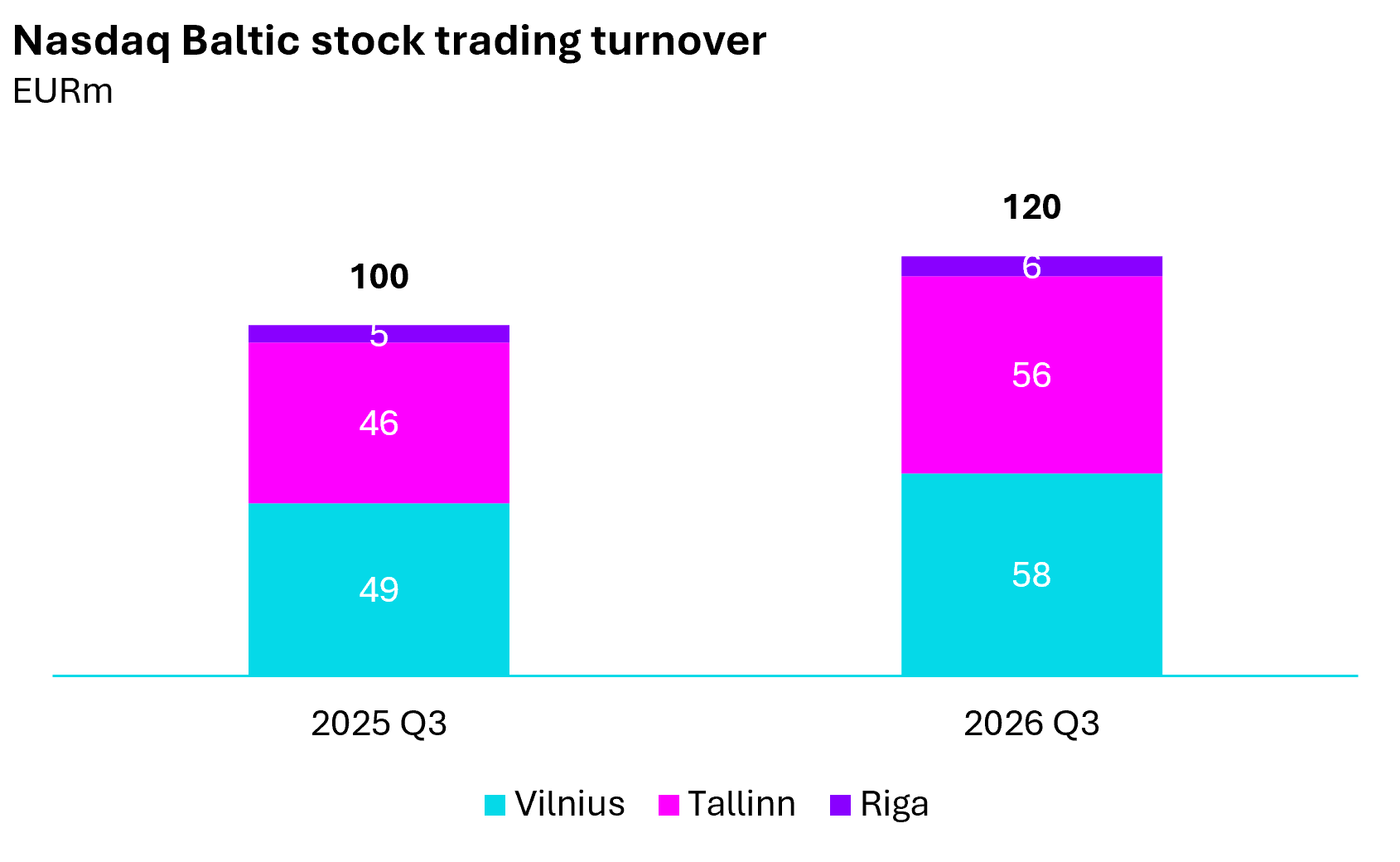
Trends were broadly similar across the individual exchanges this time. In Vilnius, equity trading turnover in the third quarter increased 17% to EUR 58m, slightly ahead of Tallinn, where turnover reached EUR 56m, up 23% year on year. Riga, the least active of the three exchanges, recorded an 18% increase to EUR 6m.
Ignitis retains its crown as the most liquid stock
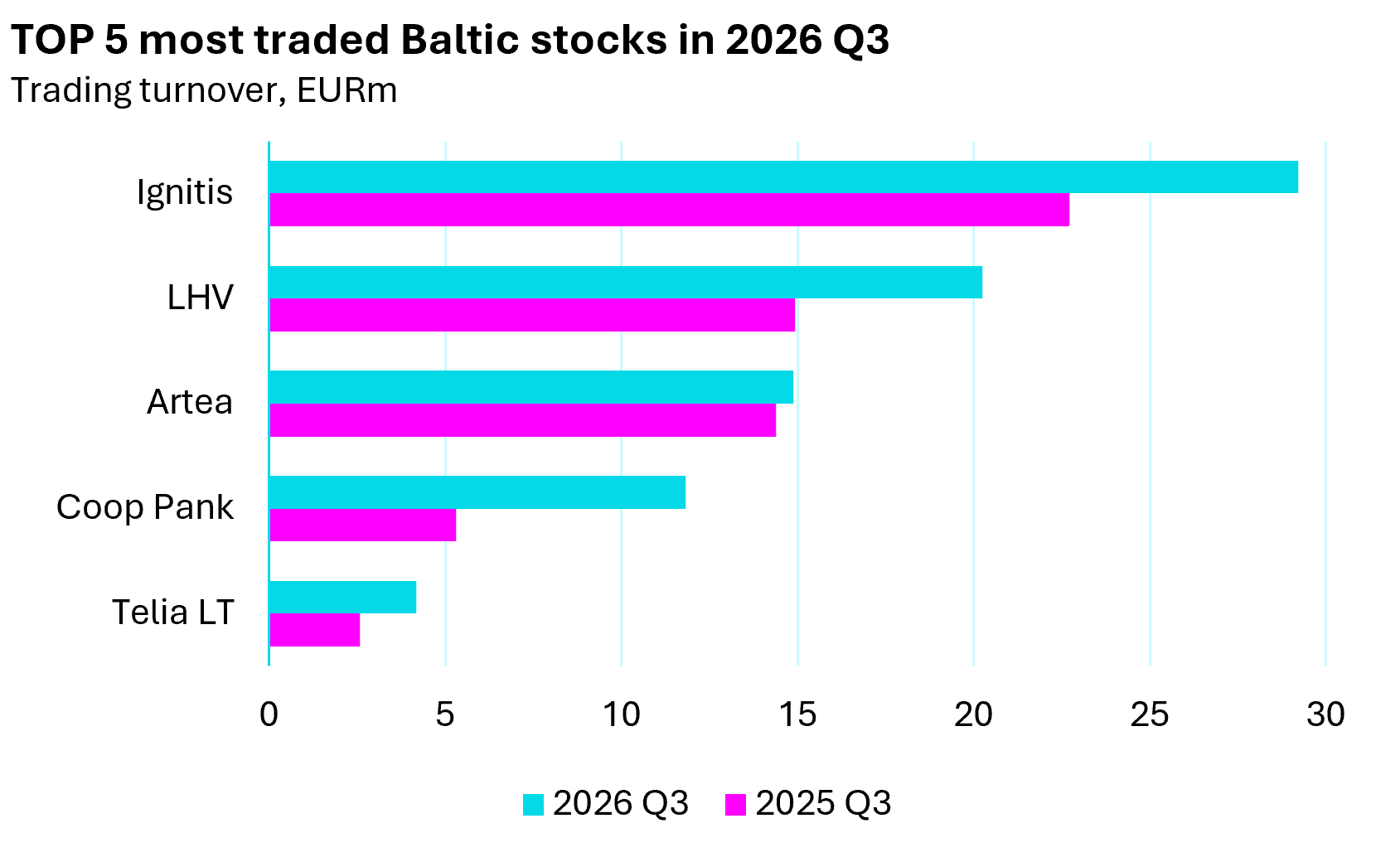
Of the nearly 70 stocks listed on Nasdaq Baltic, 30 recorded an increase in trading activity during the third quarter. All five of the most liquid stocks saw turnover rise compared with the third quarter of 2025.
Ignitis retained its position as the most actively traded Baltic stock, with turnover increasing 29% to EUR 29m. Banks occupied the next three places in the ranking. LHV turnover rose 36% to EUR 20m, Artea’s increased 3% to EUR 15m, the slowest growth among the top five, while Coop recorded the strongest increase, with turnover surging 123% to EUR 12m. Telia Lietuva rounded out the top five, with turnover rising 61% to EUR 4m.