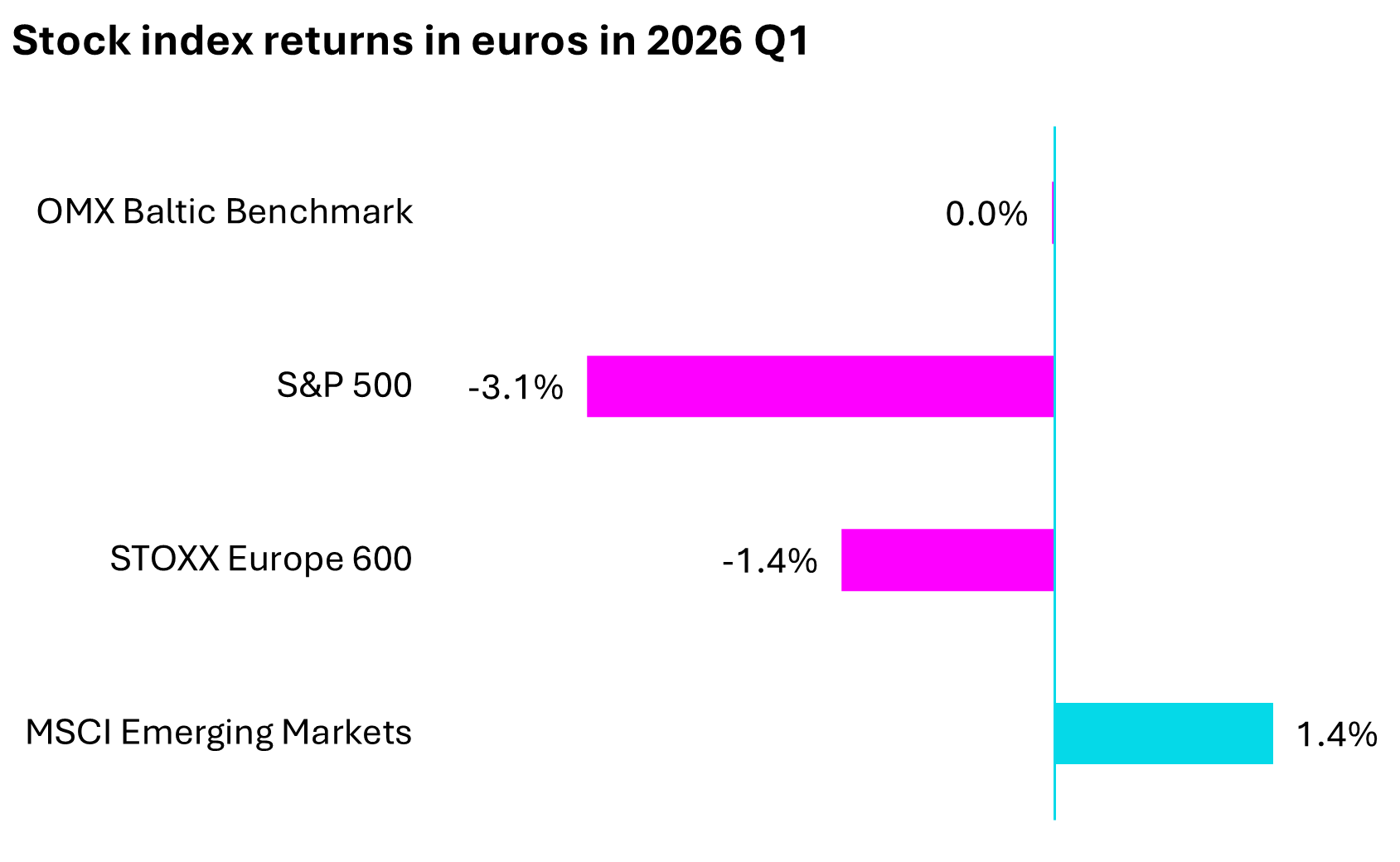
Following last year’s recovery in Baltic equity markets, positive sentiment carried into the beginning of 2026. However, it later proved unable to withstand rising uncertainty in global financial markets, triggered by the outbreak of war in Iran and the resulting surge in oil prices. At the end of January, the OMX Baltic Benchmark index reached a new all-time high of 1,790 points, up 2.6% from the end of last year. It subsequently declined and finished the first quarter at the same level as at the end of 2025.
Despite this, Baltic equities still outperformed both the US and western Europe. The S&P 500 fell 3.1% over the quarter in euro terms (down 4.6% in USD terms). STOXX Europe 600 declined 1.4%. The MSCI Emerging Markets index, which significantly outperformed developed markets last year, posted a modest gain of 1.4% in euro terms (a 0.2% decline in USD terms).
Quarter highlight: Tesonet and Artea news
In mid-March, a major announcement came from Lithuanian technology star Tesonet. It revealed an agreement to increase its stake in Artea bank from 7.3% to 31.7%, becoming the largest shareholder of the Vilnius-listed bank. Currently, the largest shareholder is Lithuanian investment group Invalda INVL, which holds 19.9% and will also sell part of its stake to Tesonet. Moreover, Tesonet announced it will seek approval from the European Central Bank to acquire a controlling stake in Artea.
This development is significant for at least two reasons. First, a closer partnership between a local bank and one of Lithuania’s largest and most advanced technology companies with global presence could have a meaningful impact on Artea’s future development. Tesonet has not yet disclosed its strategic vision for the bank. Could this become a new Revolut? A digital-first bank operating across multiple geographies? Time will tell. It will be very interesting to observe the strategic changes in Artea that may follow Tesonet becoming the largest — and potentially controlling — shareholder.
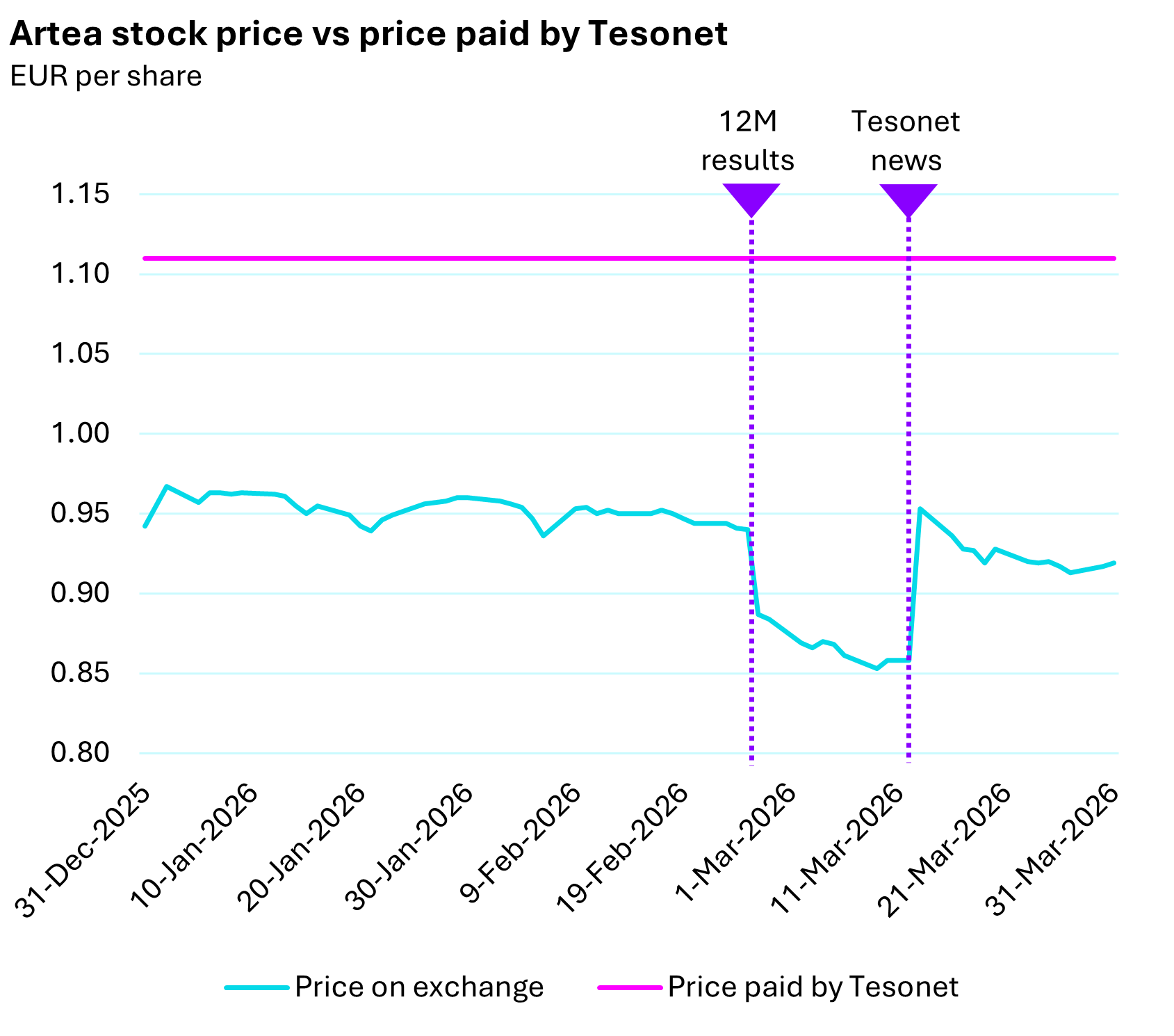
Second, the importance lies not only in the stake increase itself but also in the price paid. Investors in Baltic markets are accustomed — particularly in the context of buyouts from minority shareholders — to seeing major shareholders pay market price or even less. Tesonet, by contrast, agreed to acquire shares at a significant premium. The technology company will pay 1.2x book value. With book value per share at €0.92 at the end of 2025, this implies a price of €1.11 per share — 29% above the market price prior to the announcement. The price paid by a strategic investor signals its view of intrinsic value. Clearly, Tesonet sees significantly higher value in Artea than the market price suggests. Unsurprisingly, the share price rose 11% to €0.953 on the first trading day after the announcement. By quarter-end, it stood at €0.92, equal to book value, implying roughly 20% upside based on Tesonet’s valuation multiple of 1.2x.
Among top gainers: a long-awaited return of Harju Elekter
Out of 70 listed securities on Nasdaq Baltic, 30 recorded price increases during the quarter. Among larger companies with market capitalisation above €100m (24 companies at the end of March), the top performer was Estonia’s electrical equipment solutions provider Harju Elekter, with a gain of 15.5%.
Having been somewhat overlooked by investors and after several challenging years, the company achieved a breakthrough in 2025. By focusing on higher-margin projects and improving efficiency, it increased net profit more than threefold from €3.2m to €10.8m, despite flat revenues.
The second-best performer among larger stocks was Invalda INVL, up 10.2%. The company is set to publish its full-year results on April 8. Over the 12 months to September 2025, its net asset value rose 17% to €222m. For comparison, its market capitalisation stood significantly higher at €320m at the end of the first quarter of 2026.
The third-best performer was Telia Lietuva, whose shares rose 9.5%. The telecoms company reported that EBITDA increased 17% to €48.6m in the final quarter of last year, while net profit rose by one-third to €22.7m. In early March, it proposed a dividend of €0.14 per share, corresponding to a yield of around 7% and reinforcing its status as one of the most reliable dividend stocks in the Baltic market.
Last year’s leaders among the biggest decliners
Among the biggest decliners were also some of last year’s top performers, including Lithuanian agricultural and food group Akola and Estonian construction company Merko Ehitus.
Akola, the second-best performing large Baltic stock in 2025 (+58%), fell 15.8% in the first three months of this year. In February, the company reported a net loss of €21 thousand for its second financial quarter (October–December 2025), compared with a €7m profit a year earlier. In March, Akola carried out a share buyback via auction. Investors offered to sell nine times more shares than the company intended to repurchase. The company allowed investors to pick from three selling price levels — €1.81, €1.78 and €1.75 — compared with a pre-announcement market price of €1.725. Ultimately, shares were repurchased at €1.75. Following the buyback, the share price declined and ended the quarter at €1.55.
Merko Ehitus was the second-largest decliner, down 13.4%. In 2025, it had been the third-best performer, delivering a 50% return. The decline followed February results showing that fourth-quarter net profit fell by more than 80%, from €20m to €3m. The company proposed a dividend of €1.25 per share for 2025 — significantly lower than €1.90 the previous year. This implied a yield of 3.8% based on the pre-announcement price, relatively modest for a Baltic dividend stock.
The third-largest decline was recorded by Lithuanian gas transmission operator Amber Grid, down 9.2%. At the end of February, the company reported that net profit fell from €8.3m to €1.4m. However, adjusted net profit — excluding temporary regulatory differences — remained stable at €10m. This implies that lower-than-expected revenue or higher-than-expected costs in 2025 will be compensated through higher tariffs in the future. At the end of March, the company proposed a dividend of €0.056 per share (nearly 5% yield), only slightly below €0.06 the previous year. In absolute terms, the proposed dividend corresponds to €10m, broadly in line with adjusted net profit.
Investor activity growth stalls again
Last year saw a recovery in investor activity after a three-year decline. Total trading turnover on Nasdaq Baltic rose 40% to €562m in 2025, and in the second half of the year Vilnius overtook Tallinn as the most liquid Baltic exchange.
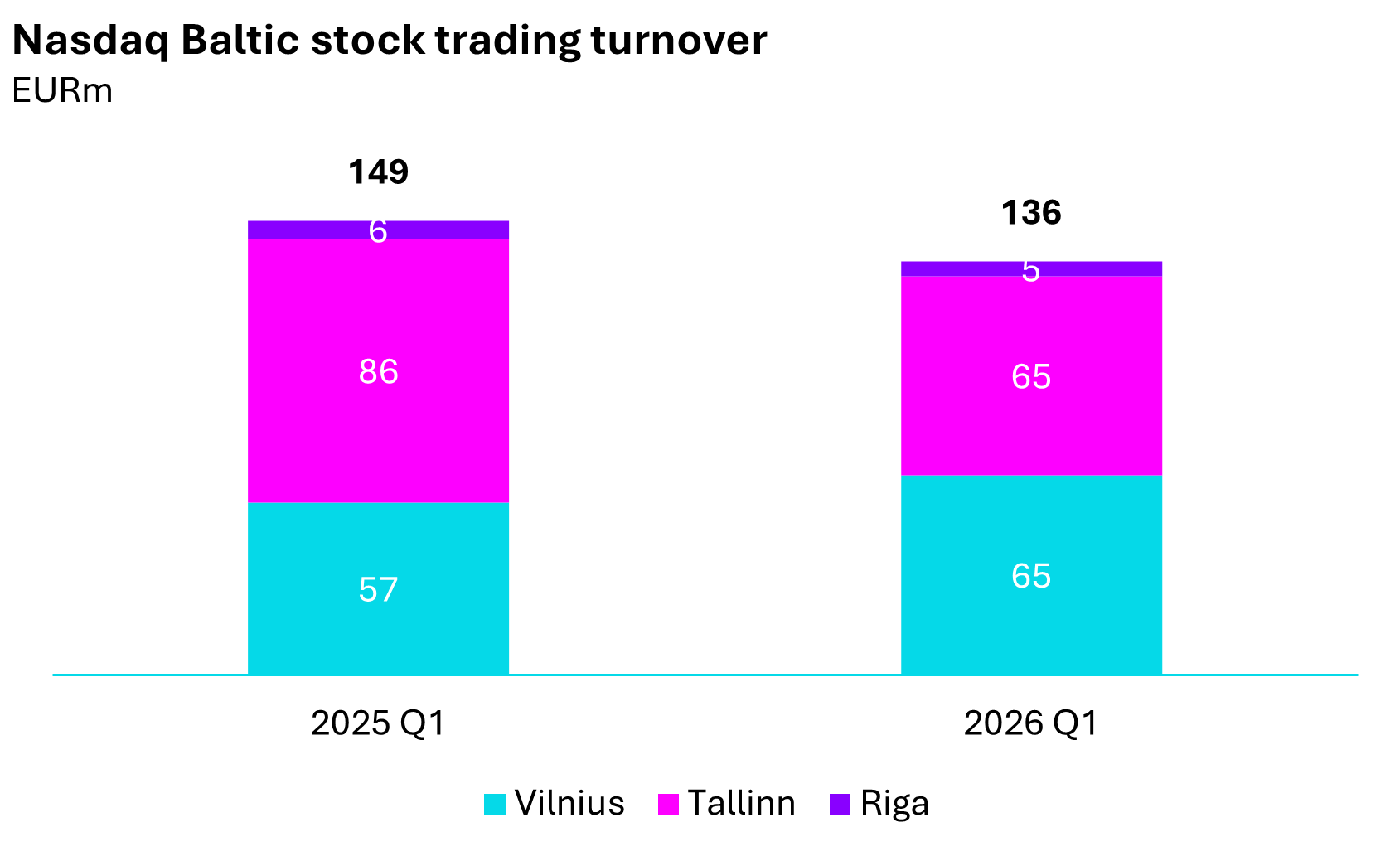
However, this growth stalled at the start of this year. After four consecutive positive quarters, total turnover across the three exchanges declined 9% year-on-year to €136m in the first quarter. The trend mirrored broader market sentiment: trading volumes still rose 17% in January but declined significantly in February and March.
Investor activity diverged between Vilnius and Tallinn. Turnover continued to grow in Vilnius, while it declined in Tallinn, partly due to the absence of one of the most liquid stocks — renewable energy producer Enefit Green — which had generated €25m in turnover in the first quarter of last year before being delisted in July.
In Vilnius, turnover rose 16% to €65.5m — the most active first quarter since 2023. In contrast, Tallinn saw a 25% decline to €65.1m, slightly below Vilnius. Riga also recorded a negative trend, with turnover falling 17% to €5m, representing just 4% of total Nasdaq Baltic trading.
Telia Lietuva enters top five most traded stocks
Out of 70 listed securities, 36 recorded increased investor activity. The most liquid stock of the first quarter of 2025 — Enefit Green — is no longer present following its delisting.
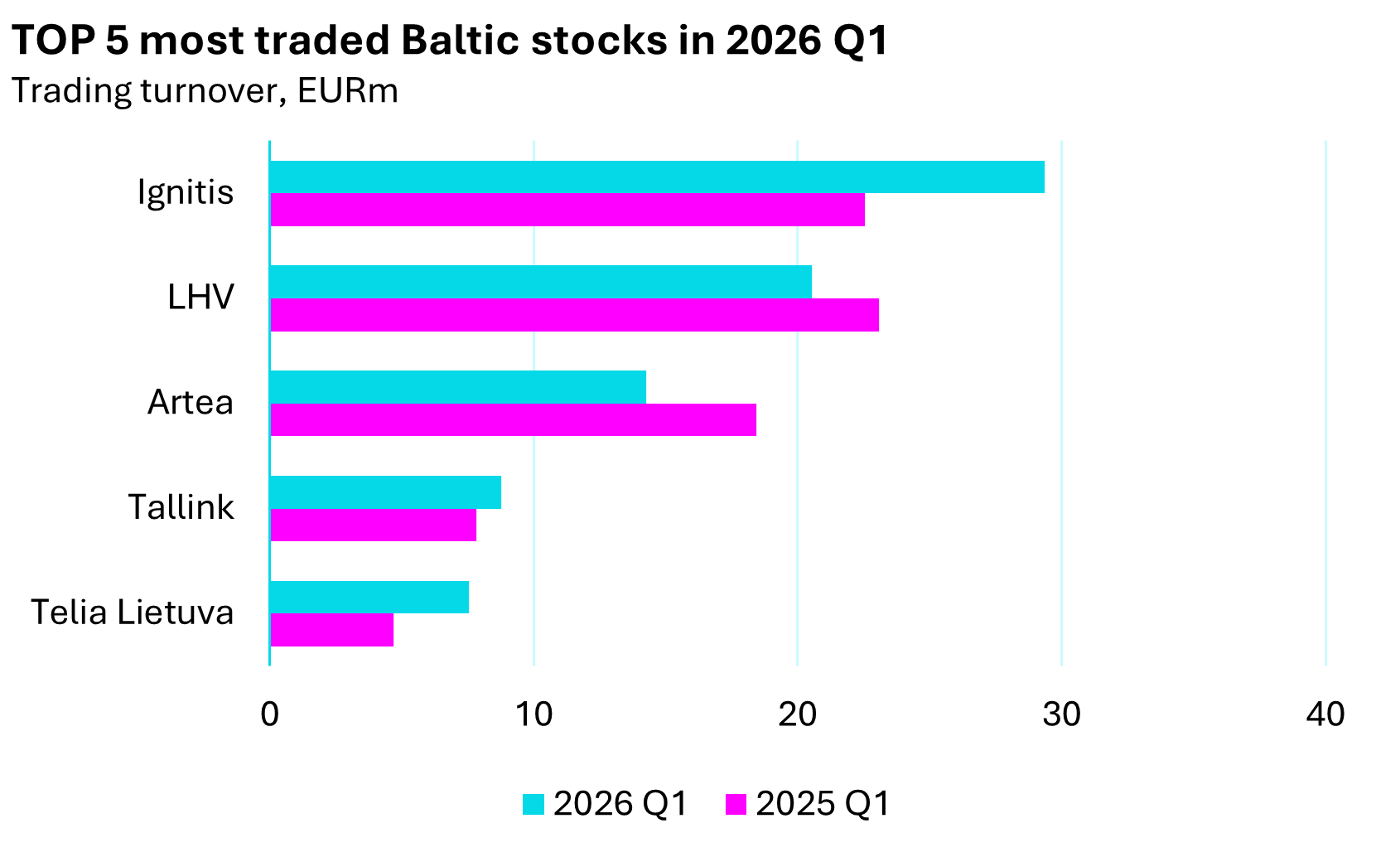
Telia Lietuva entered the top five most traded stocks, rising from 10th to 5th place, with turnover increasing 61% to €8m. As a result, the top five now includes three Lithuanian and two Estonian companies — a shift from the previously dominant Estonian presence.
Ignitis, last year’s leader, remained the most actively traded stock, with turnover reaching €29m, up 30% year-on-year. Second and third places were held by bank stocks — Estonia’s LHV (€21m) and Lithuania’s Artea (€14m) — both recording lower turnover. Estonian ferry operator Tallink ranked fourth with €9m in turnover, up 12% from a year earlier.