

The economies of Lithuania, Latvia and Estonia have made striking progress. Their gap in GDP per capita relative to the EU average has narrowed significantly. Regrettably, the same progress has not been replicated in capital markets.
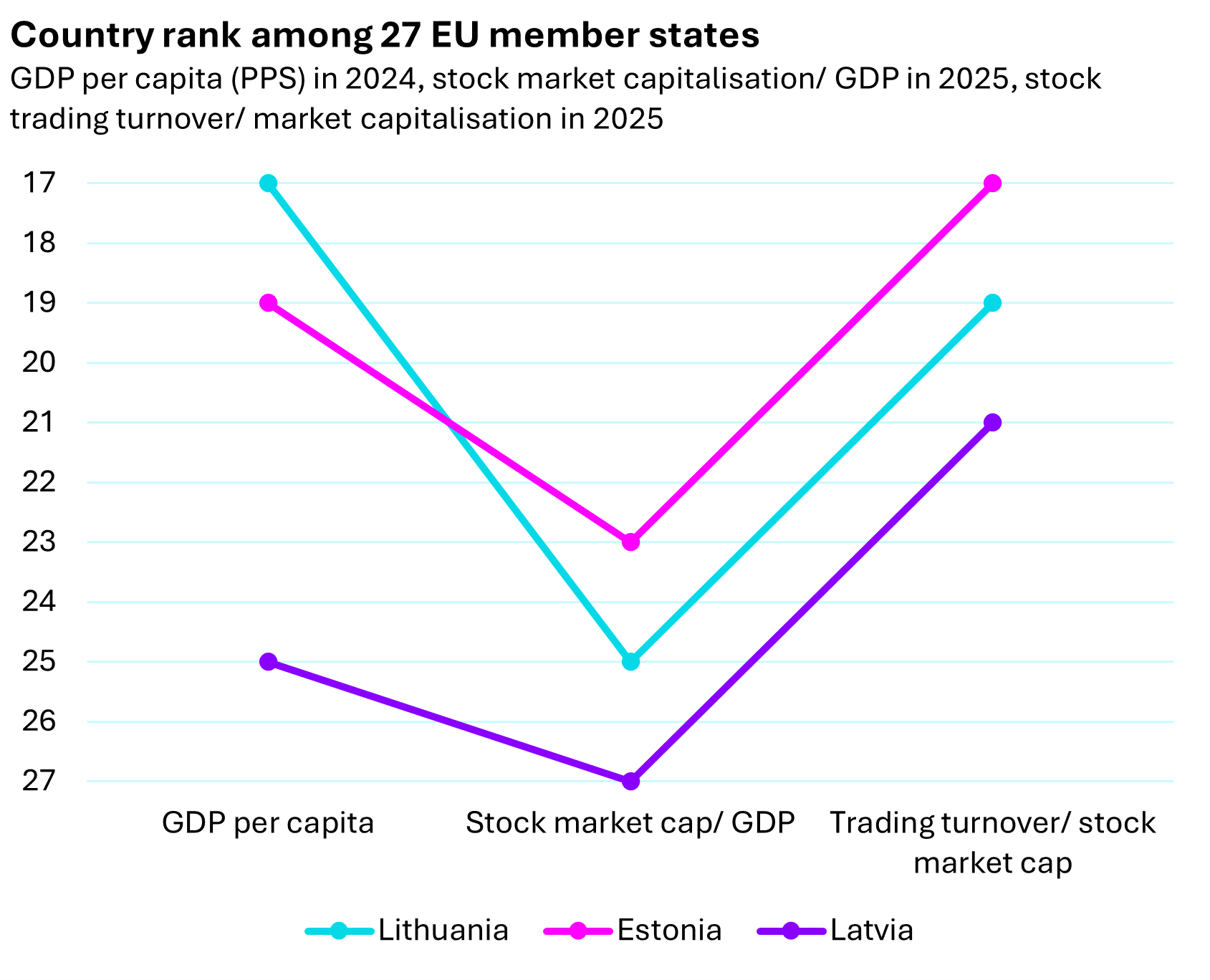
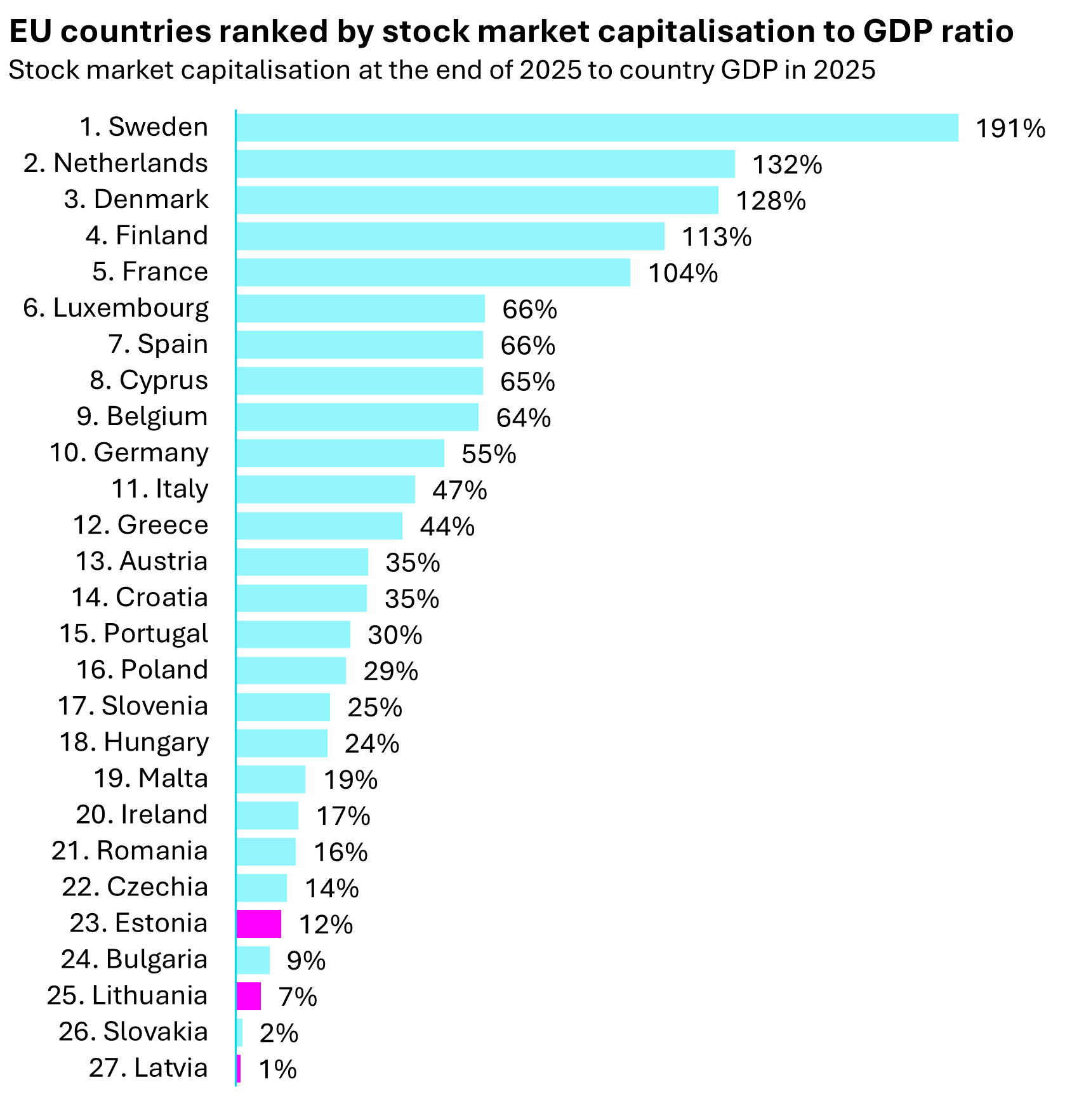
By relative stock market size — measured as the ratio of market capitalisation to GDP — the Baltic states rank near the bottom among the EU’s 27 members. Estonia stands 23rd, Lithuania 25th and Latvia last, in 27th place. More broadly, eastern European countries, whose stock exchanges only opened after 1990, lag well behind their western European peers.
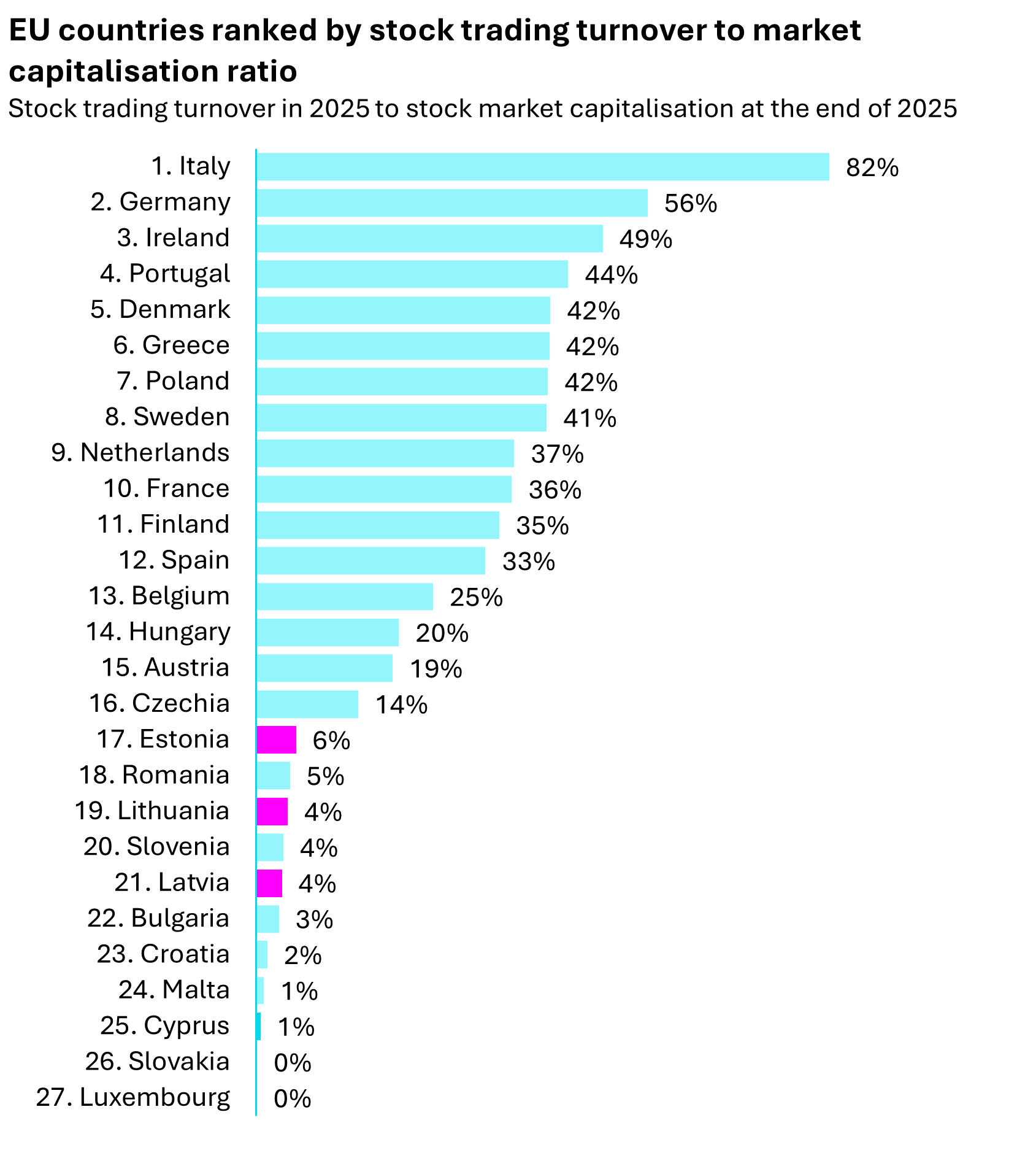
By investor activity, Baltic equity markets appear somewhat stronger, though still well below the EU average. Ranking member states by the ratio of annual stock trading turnover to market capitalisation, Estonia places 17th, Lithuania 19th and Latvia 21st. While equity markets in the region are very small, listed companies tend to be traded relatively actively. This suggests that the more pressing issue is the shortage of listed companies rather than weak investor participation. To foster the development of Baltic equity markets, the primary focus should be on attracting new, sizeable companies to list.
Strong macroeconomic progress
All three Baltic countries rank among the EU’s strongest performers in terms of economic convergence. Lithuania’s GDP per capita in purchasing power standards reached 87% of the EU average in 2024 — an increase of 28 percentage points since 2010, the second-largest improvement after Ireland over that period. Lithuania now ranks 17th among EU member states, up from 24th in 2010.
Estonia’s GDP per capita stood at 79% of the EU average in 2024, up 14 percentage points since 2010, placing it 19th in the EU.
Latvia’s figure reached 69% of the EU average, an increase of 17 percentage points, ranking 25th among member states.
Baltic markets near the bottom by capitalisation-to-GDP
The most widely used metric for assessing stock market development is the ratio of total market capitalisation of listed companies to GDP. This indicator captures the size of the equity market relative to the economy and enables cross-country comparison.
Across the EU in 2025, Sweden ranked first, with market capitalisation equivalent to 193% of GDP — meaning the value of stocks traded in Stockholm was nearly double the size of the economy. The Netherlands ranked second at 132%, followed by Denmark at 128%. In total, five EU countries recorded stock market capitalisation exceeding annual GDP. The EU-wide weighted average stood at 68%.
The Baltic states fall far short of this benchmark and occupy the lower end of the ranking. Estonia leads the region in 23rd place, with market capitalisation at 9% of GDP — roughly six times below the EU average. Lithuania ranks 25th, with a ratio of 7%, or around ten times lower than the EU average. Latvia ranks last, with capitalisation at just 1% of GDP — 49 times below the EU average.
Eastern Europe lags behind the west
The Baltic underperformance reflects a broader regional pattern. Eastern European countries — largely newer EU members — trail western European economies. When ranked by market capitalisation-to-GDP, the upper half of the table is dominated by western Europe, while eastern European countries are concentrated in the lower half.
The highest-ranked eastern European markets are Croatia (14th, 35%) and Poland (15th, 29%), both still roughly half the EU average.
This gap is largely explained by history. Stock exchanges across the Baltic states and much of eastern Europe were established only after 1990, following the collapse of the Soviet system and the transition to market economies. By contrast, western Europe benefits from deep-rooted capital market traditions spanning centuries. The Amsterdam exchange — widely regarded as the world’s first — dates back to the early 17th century.
Investor activity paints a more favourable picture
Another key measure of market development is the ratio of annual equity trading turnover to market capitalisation, which captures how actively investors trade listed shares.
In 2025, Italy ranked first in the EU, with turnover equivalent to 82% of market capitalisation. Notably, Italy ranks only 11th by market size, indicating that relatively smaller markets can still sustain high trading activity. Germany came second at 56%, followed by Ireland at 49%. The EU weighted average stood at 43%.
The Baltic markets perform somewhat better on this metric, though still lagging significantly behind the EU average. Estonia ranks 17th, with turnover at 5.7% of market capitalisation in 2025. Lithuania follows in 19th place at 4.5%, while Latvia ranks 21st with 3.7%.
Interestingly, relatively higher trading activity in the Baltic states is driven primarily by domestic retail investors rather than foreign or institutional participants.
At the bottom of the ranking are Cyprus, Slovakia and Luxembourg, where trading turnover does not reach even 1% of market capitalisation.
A shortage of listings, not investors
Debate about the underdevelopment of Baltic equity markets often centres on a “chicken-and-egg” problem: there are too few listed companies because there are not enough investors, and too few investors because there are not enough listed companies.
However, comparing the two development indicators offers useful insight. The Baltic states rank higher within the EU by trading activity than by market size. This suggests that while markets are small, existing listed companies are traded relatively actively — even if still below EU averages.
The implication is that the primary constraint is the lack of listed companies rather than insufficient investor demand.
To accelerate development, efforts of market participants should prioritise attracting new, large companies with meaningful free floats to public markets. This would broaden investment opportunities for existing participants and likely help attract new investors, both domestically and internationally.
Scandinavia as a benchmark
Scandinavia — geographically and culturally close to the Baltic region — stands out for its highly developed capital markets. Sweden, Denmark and Finland all rank among the top four EU countries by market capitalisation-to-GDP (alongside the Netherlands).
They also perform strongly in terms of trading activity: Denmark ranks 5th, Sweden 8th and Finland 11th.
Even in absolute terms, these markets are sizeable. Sweden is the EU’s fourth-largest equity market, despite being only the 11th-largest member state by population. Denmark ranks 16th by population, and Finland 17th.
Scandinavia demonstrates that even relatively small countries can sustain deep and active capital markets — offering a compelling model for the Baltic states to follow.