


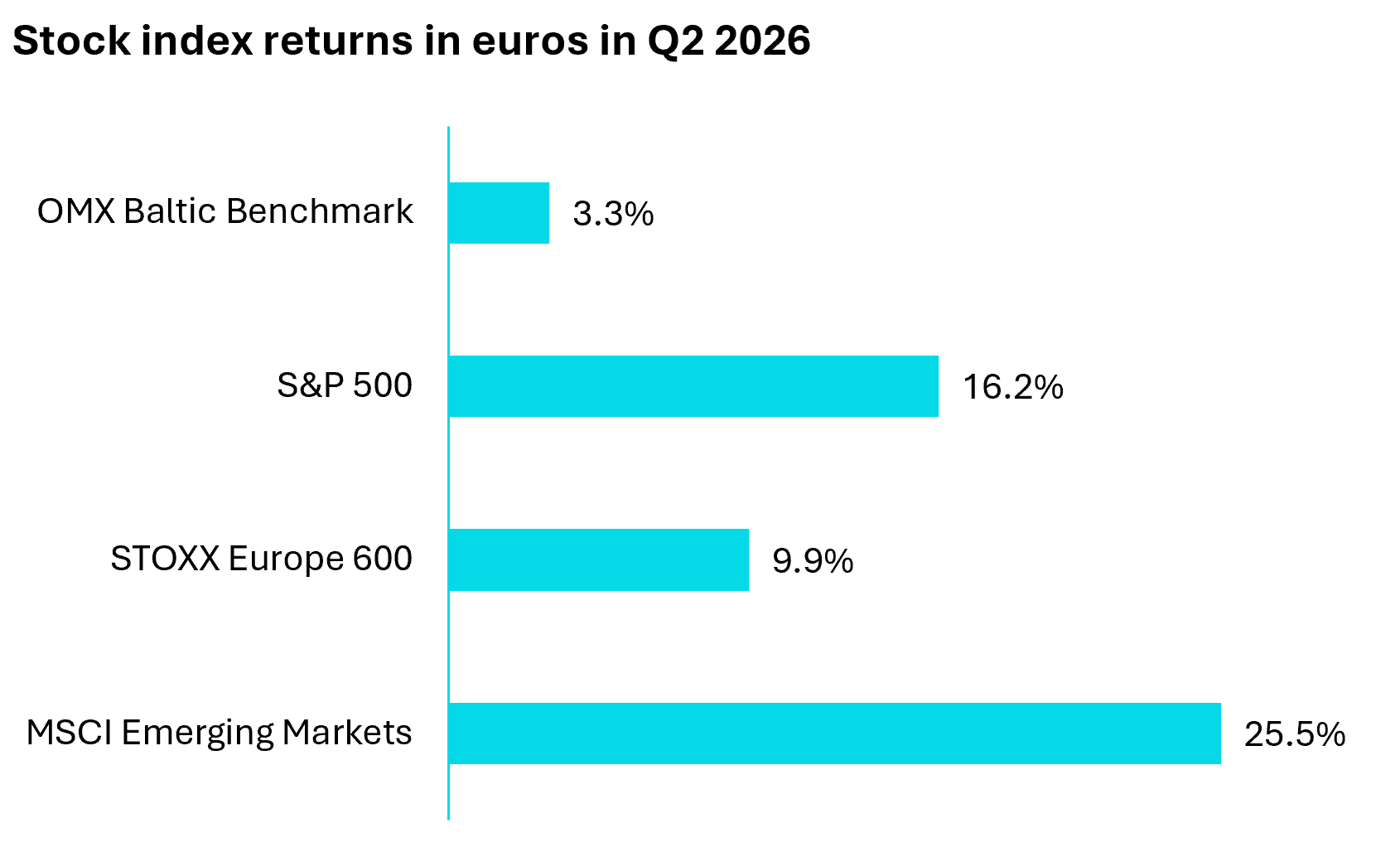
Baltic equities posted gains in the second quarter but significantly lagged the stronger rally in international markets. The OMX Baltic Benchmark index rose 3.3%, held back primarily by Estonian and Latvian stocks. Tallinn’s main index gained just 2.1%, while Riga advanced 3.2%. Vilnius, by contrast, was much closer to global market trends, climbing 8.1%. Despite the relatively modest quarterly performance, the OMX Baltic Benchmark reached a new all-time high in early May.
International equity markets also hit record highs. Compared with Baltic stocks, they rebounded much more strongly after a weak first quarter, when investor sentiment was shaken by the outbreak of war in Iran and the resulting spike in oil prices. Optimism returned during the second quarter as investors increasingly anticipated an end to hostilities in the Middle East and oil prices retreated. Artificial intelligence-related stocks also rallied.
Over the three months to the end of June, the S&P 500 gained 16.2% in EUR terms (14.9% in USD). Europe’s STOXX Europe 600 rose a more moderate 9.9%. Emerging markets delivered particularly strong returns, driven by AI-related semiconductor companies in South Korea and Taiwan. The MSCI Emerging Markets Index surged 25.5% in EUR terms, its strongest quarterly performance since 2009. South Korean equities rose by around 50%, while Taiwanese stocks gained approximately one-third.
Unlike bond issues, Baltic equity IPOs failed to generate investor interest
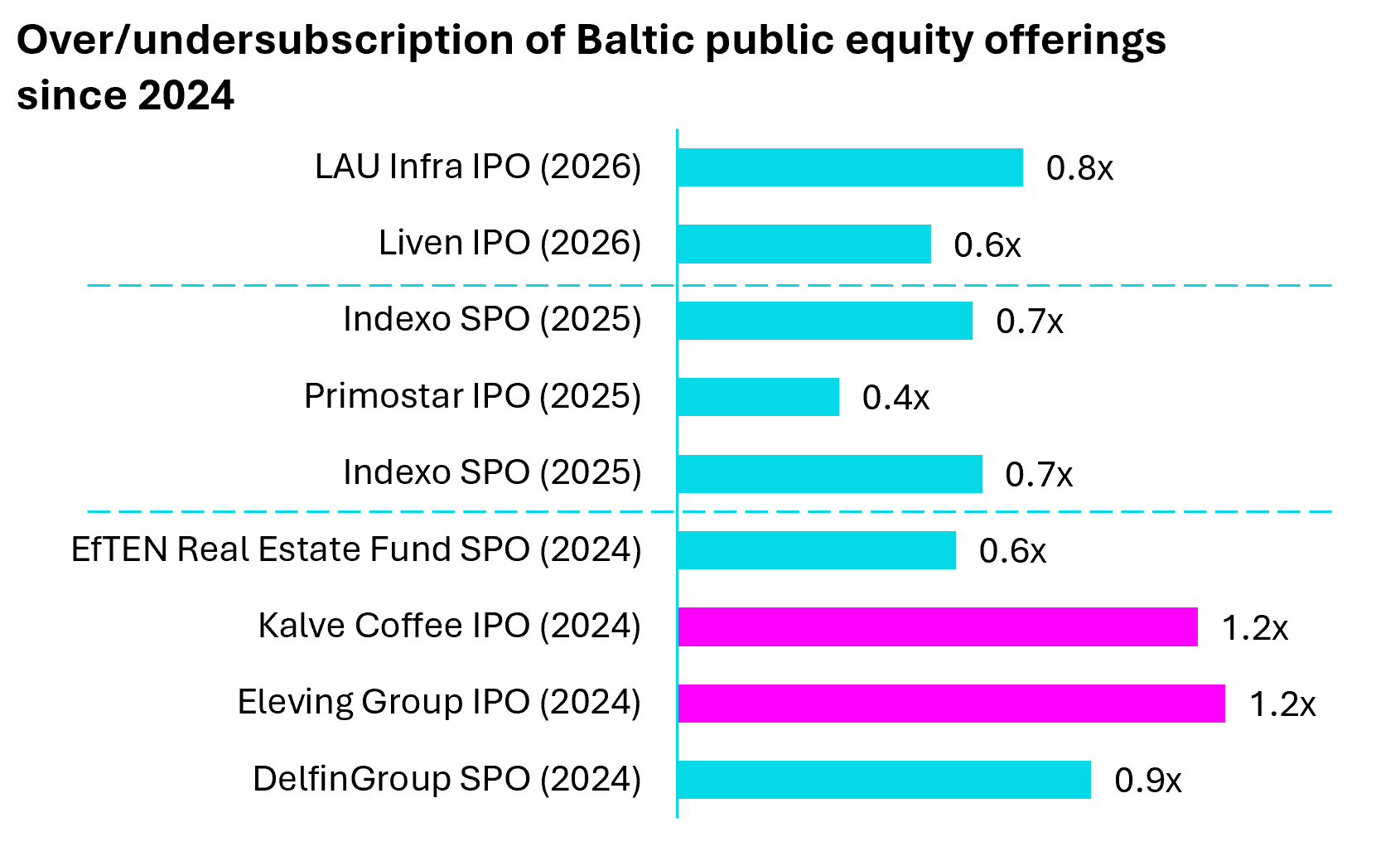
The second quarter saw the first Baltic equity IPOs of the year, with Estonia’s Liven and Latvia’s LAU Infra coming to market. At the same time, global investors had found a “new crypto”. Everyone went crazy about Elon Musk’s SpaceX IPO. Unfortunately, Baltic IPOs generated nothing comparable, not even compared with recent Baltic bond offerings. Although both IPOs attracted a respectable number of investors, around 2,000 or more in each case, neither company managed to sell the full amount of shares on offer.
In May, Estonian residential property developer Liven raised EUR 4.9m of equity from 2,421 investors. However, it sold only 67% of the shares offered. By the end of June, its share price was 22% below the IPO price, giving the company a market capitalisation of EUR 48m. Liven was far from a newcomer to the capital markets. It had previously completed two successful EUR 6m bond issues. The first, launched in May 2024, was 3.6 times oversubscribed, while the second, completed in March 2025, was 2.1 times oversubscribed.
The contrast illustrates just how much stronger demand from local investors remains for bonds than for equities. Raising equity capital through an IPO is currently far more difficult than raising debt through the bond market in the Baltics.
At the end of June, Latvia’s state-controlled road construction and maintenance company LAU Infra completed its IPO, raising EUR 6.2m after selling 77% of the shares offered. The offering attracted 1,981 investors. The shares began trading on Nasdaq Riga on 3 July. By mid-July, they were trading broadly in line with the IPO price, implying a market capitalisation of around EUR 55m.
Where have the local institutional investors gone?
The last time a Baltic equity offering (an IPO or a secondary placement) was oversubscribed was in November 2024 when Latvian coffee company Kalve Coffee went public. Since then, all six public equity offerings have failed to raise their target amount, with companies placing, on average, only 60% of the shares offered.
The shortage of institutional investors has become increasingly evident in the Baltic capital market. International institutions have never been particularly active, especially in smaller offerings, but recently even local institutions have largely stepped back.
In Lithuania, domestic pension funds have traditionally been the most important institutional investors. However, following the pension reform that allows savers to withdraw assets accumulated in the second pillar, pension funds are now more focused on exiting their investments than making new ones. If the likelihood of new IPOs in Lithuania was previously limited, it has now become microscopic.
Vilkyškių pieninė and KN Energies continued their strong run
Of the 70 equity securities listed on Nasdaq Baltic, 31 gained during the second quarter. Among companies with a market capitalisation of at least EUR 100m (24 at the end of June), the strongest performer was Lithuanian dairy producer Vilkyškių pieninė whose shares rose 38.9%. The company has been one of the Baltic market’s best-performing stocks in recent years. Since the beginning of 2024, its share price has tripled.
At the end of May, Vilkyškių pieninė reported first-quarter revenue of EUR 87m, up 22% year-on-year, while net profit increased 26% to EUR 5.1m. The company also announced that, following the opening of its new cheese factory in Latvia and the acquisition of Marijampolės Pieno Konservai, it expects revenue to increase by around 50% this year to EUR 430m. Over the longer term, management believes existing production capacity can support annual revenue of EUR 600m. The company paid a dividend of EUR 0.23 per share for 2025, equivalent to a dividend yield of around 2%.
Shares in Lithuanian electricity transmission operator Litgrid gained 15.9%, making it the second-best performing large-cap stock during the quarter. The company reported first-quarter adjusted EBITDA of EUR 15.2m, up 7%, while adjusted net profit declined 5% to EUR 7.8m. Litgrid also paid a dividend of EUR 0.054 per share, representing a dividend yield of just over 5%.
Third place went to oil and LNG terminal operator KN Energies, whose shares advanced 13.6%. Like Vilkyškių pieninė, it has been one of the Baltic market’s strongest performers in recent years, with its share price more than doubling since the beginning of 2024. At the end of May, KN Energies reported first-quarter revenue of EUR 29.8m, up 18%, while net profit jumped by two-thirds to EUR 7.3m. The improvement was driven by higher earnings from both its regulated business and commercial LNG activities. The company also paid a 2025 dividend of EUR 0.029 per share, corresponding to a yield of approximately 6%.
Tallinn port and banks among the weakest performers
Tallinna Sadam, the operator of Tallinn port, was the worst-performing large-cap Baltic stock during the second quarter, with its shares falling 8.7%. Investors reacted negatively to the company’s first-quarter results. Revenue slipped only 0.7% to EUR 28.1m, but adjusted EBITDA fell 17% to EUR 11.6m and net profit dropped 33% to EUR 4.6m. In early July, the company also reported continued declines in passenger and cargo volumes during the second quarter. The company paid a 2025 dividend equivalent to a yield of around 5%.
The banking sector also disappointed investors. Estonia’s LHV (-5.4%) and Lithuania’s Artea (-5.0%) were the second and third weakest-performing large-cap stocks of the quarter. Both banks paid dividends in April, with yields of approximately 5%. However, their first-quarter results failed to impress investors. LHV reported a 32% decline in net profit to EUR 19.7m, while net interest income fell 4%. Artea’s net profit declined 13% to EUR 15.4m despite a 4% increase in net interest income. Both banks nevertheless continued to expand lending. Compared with the end of 2025, LHV’s loan portfolio increased by 2%, or EUR 120m, while Artea’s grew by 1%, or EUR 42m.
In March, Tesonet announced an agreement to increase its stake in Artea from 7.3% to 31.7% by acquiring shares from existing major shareholders at a valuation of 1.2x book value, currently equivalent to EUR 1.08 per share. Artea’s market price still remained around 20% below the price paid by Tesonet.
Investor activity declines as withdrawn private pensions in Lithuania fail to reach the stock market
Last year’s recovery in Baltic equity trading now appears to have been short-lived. Investor activity slowed even more sharply in the second quarter than in the first.
Total turnover across the three Baltic exchanges reached EUR 127m during the quarter, down 29% from a year earlier. January was the only month this year to record year-on-year growth in trading activity. The following five months all posted declines.
Part of the decline reflects unusually high trading volumes in Enefit Green shares during the first half of last year after the company announced plans to delist. The stock left the exchange in July 2025.
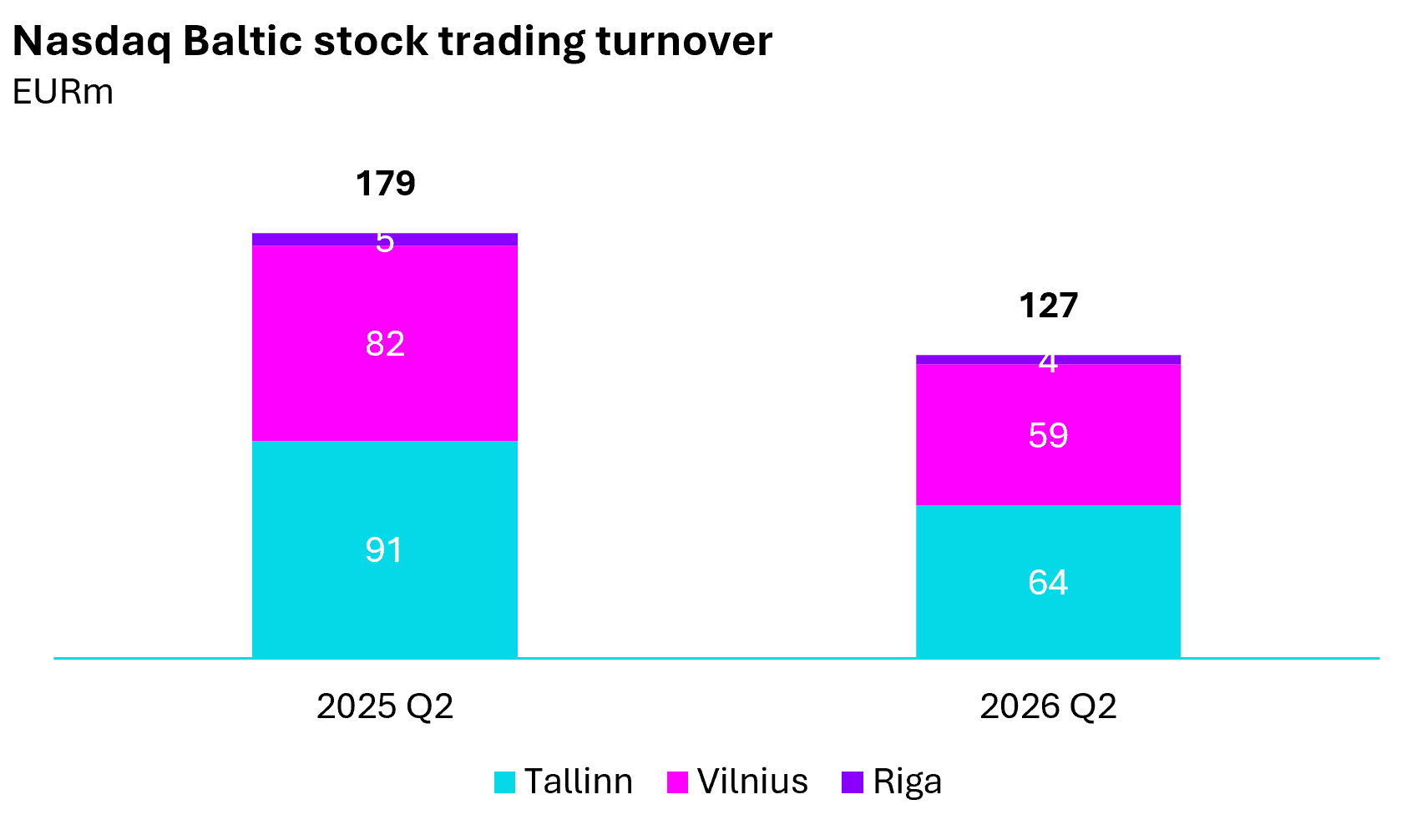
Trading activity weakened at a broadly similar pace across all three Baltic exchanges. Vilnius, which had been the region’s most active exchange during the fourth quarter of last year and the first quarter of this year, ceded that position back to Tallinn.
Turnover on Nasdaq Vilnius fell 28% to EUR 59m, while Tallinn recorded a 30% decline to EUR 64m. Excluding the impact of Enefit Green’s delisting, Tallinn’s turnover would have fallen by only 6%. Against that backdrop, the almost one-third decline in trading activity in Vilnius appears even more striking.
There had been hopes that at least part of the money withdrawn from Lithuania’s second-pillar pension system this year would find its way back into the domestic equity market. The sums involved were substantial. During the first withdrawal window in April alone, savers withdrew assets equivalent to around 40% of total second-pillar pension assets.
However, the sharp decline in turnover on the Vilnius exchange suggests that this hope has remained just that. Instead of being reinvested in equities, much of the money appears to have been “invested” in washing machines and all-inclusive holidays in Turkey.
Ignitis remains the Baltic market’s most actively traded stock
Of the 70 securities listed on Nasdaq Baltic, 31 recorded higher trading activity during the second quarter. The five most actively traded stocks included two Lithuanian and three Estonian companies. Trading volumes in the Lithuanian names declined significantly compared with the second quarter of 2025, while the Estonian companies all recorded higher turnover.
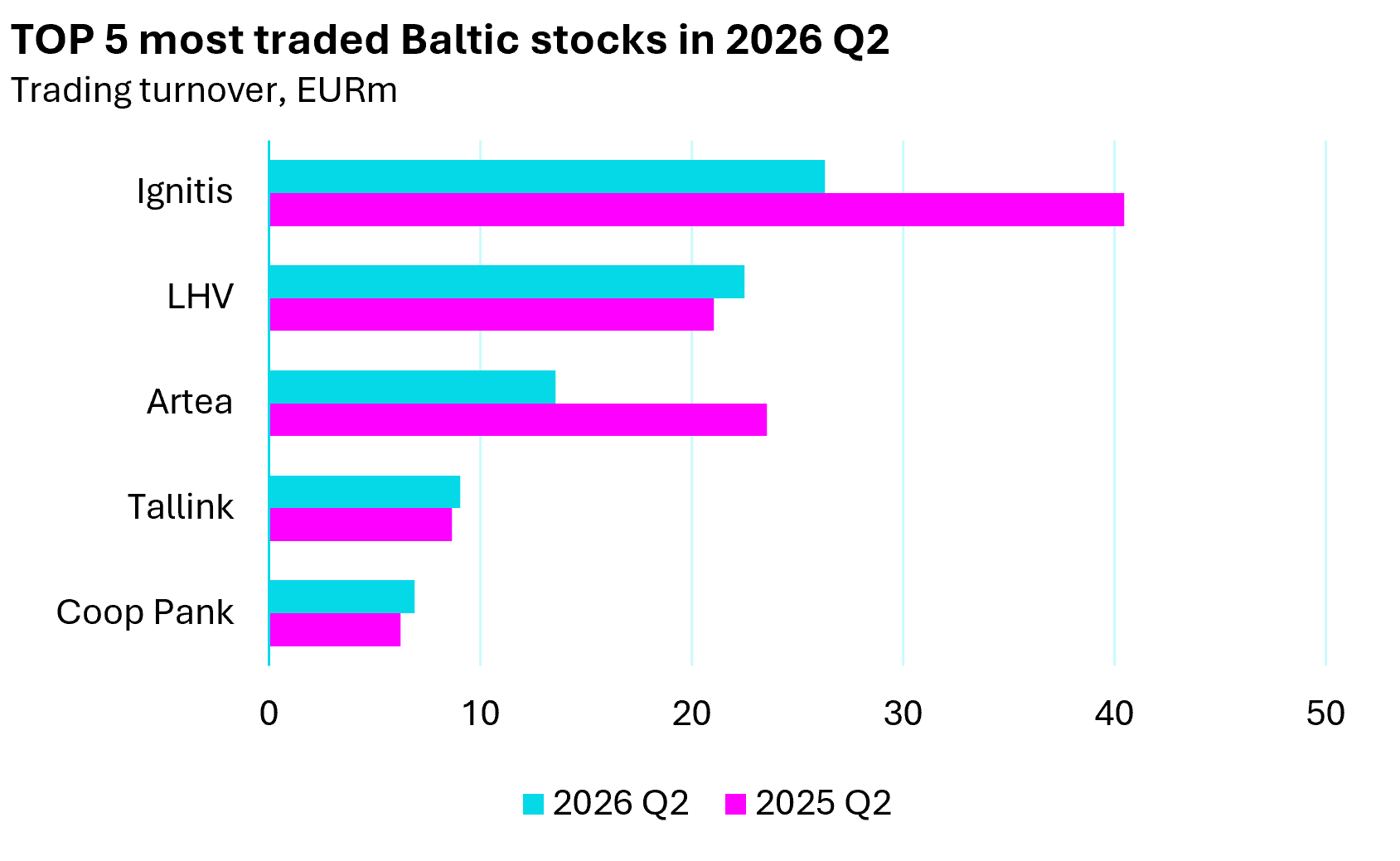
Ignitis retained its position as the Baltic market’s most actively traded stock, despite turnover falling 35% year-on-year to EUR 26m. Artea was the only other Lithuanian company in the top five. Its turnover declined 42% to EUR 14m, leaving it in third place.
LHV ranked second with turnover of EUR 22m, up 7% year-on-year. Estonian ferry operator Tallink held fourth place, with turnover increasing 5% to EUR 9m. The top five was completed by Coop Pank, whose turnover rose 10% to EUR 7m. The Estonian lender replaced Telia Lietuva, which had entered the top five during the first quarter.