

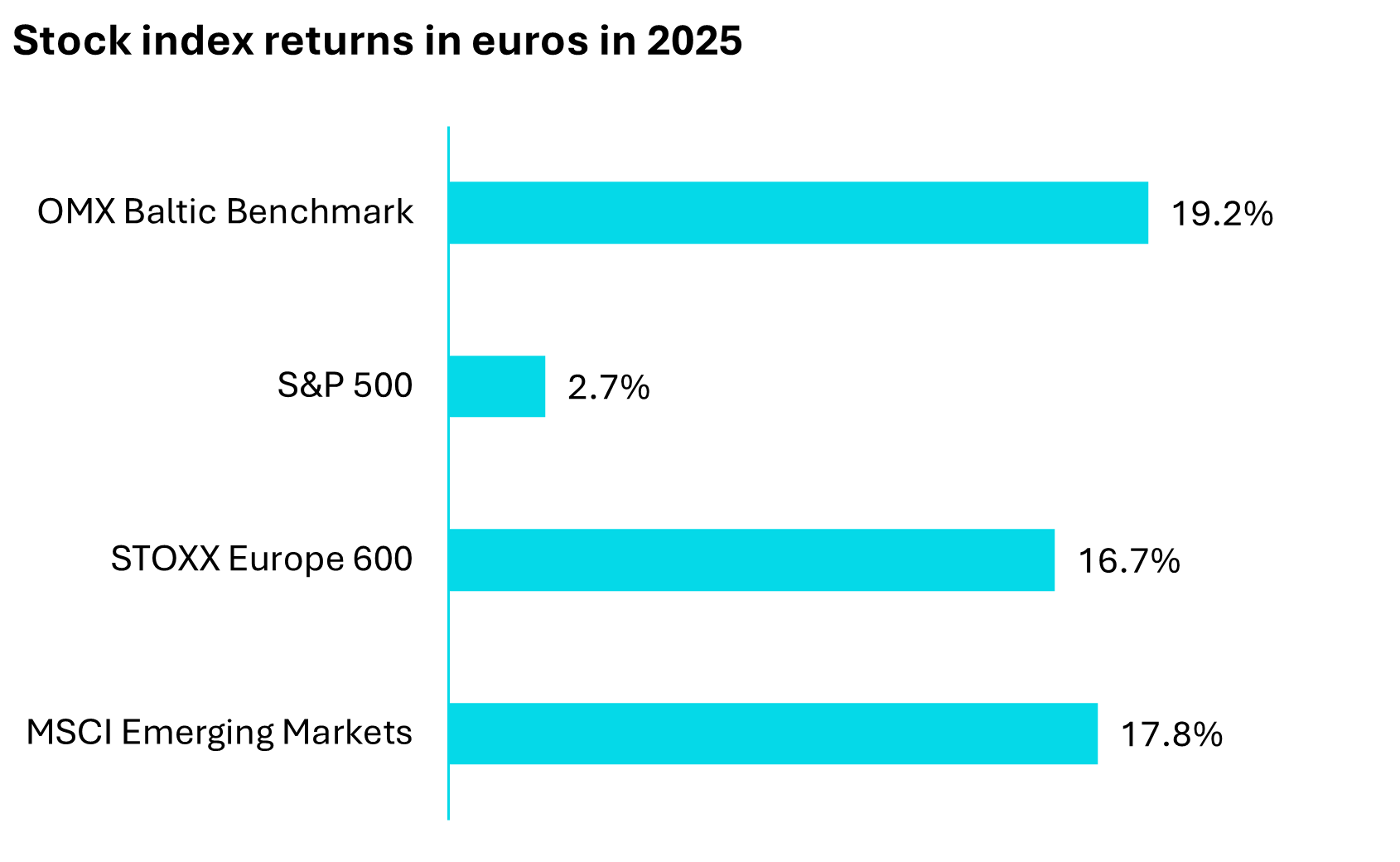
The main Baltic equity index, the OMX Baltic Benchmark, rose by 19 per cent and reached a new all-time high on the final trading day. The previous peak had been recorded more than four years earlier, in September 2021. That date is closely linked to a key topic shaping Baltic — and especially Lithuanian — equity markets this year. September 2021 was the first month in which participants in Estonia’s second-pillar pension funds were allowed to withdraw their savings.
The rally in Baltic equities in 2025 coincided with a pick-up in European and emerging market equities. The local benchmark slightly outperformed the STOXX Europe 600 (+17%) and the MSCI Emerging Markets Index (+18% in euro terms). Baltic stocks also delivered a markedly better result than US equities: following a 13% decline in the US dollar, the S&P 500 returned just 3% when measured in euros.
Looking at the three Baltic markets individually, Lithuanian equities delivered the strongest performance. The OMX Vilnius index rose by 26%, outperforming both OMX Tallinn (+18%) and OMX Riga (+6%).
Three in four stocks appreciated
Out of 69 listed companies, as many as 52 recorded positive share price performance over the year. The strength of the market is further illustrated by the fact that among companies with a market capitalisation above €100m, not a single stock declined in value.
Lithuanian companies dominated the list of top performers among larger names, while Estonian stocks were more prevalent among the laggards. The strongest performers of the year were KN Energies (+71%), Akola (+58%), Merko Ehitus (+50%), Vilkyškių pieninė (+44%) and Rokiškio sūris (+27%).
At the other end of the spectrum were TKM Grupp (+0.3%), Tallink (+1%), EfTEN Real Estate Fund (+1%), Eleving (+2%) and Infortar (+6%).
Investor activity reaches a three-year high
Equity trading turnover on Nasdaq Baltic had declined for three consecutive years, falling from €917m in 2021 to €401m in 2024. In 2025, that trend finally reversed. Aggregate turnover across the three Baltic exchanges rose by 40% to €562m, the highest level in three years.
Liquidity grew most rapidly in Vilnius, where turnover jumped by 71% to €256m, accounting for 46% of total Nasdaq Baltic turnover. Activity increased more modestly in Tallinn, rising by 19% to €284m, or 50% of the total.
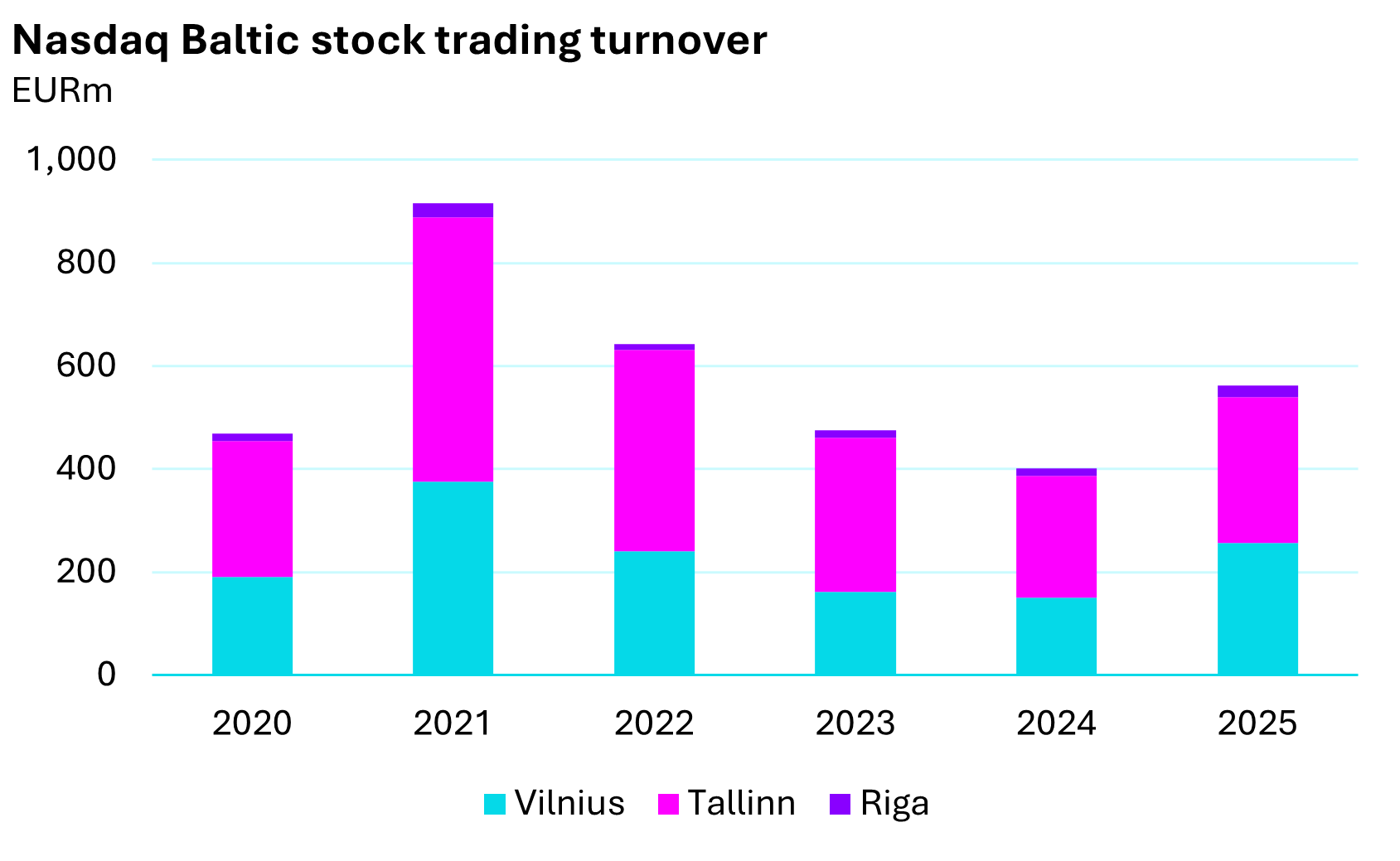
Although Tallinn remained ahead of Vilnius on a full-year basis, trading volumes in Vilnius exceeded those in Tallinn during the second half of the year, following the delisting of Enefit Green. As a result, Vilnius assumed the position of the most active Baltic exchange — a notable achievement, given that turnover in Tallinn had been roughly 1.5 times higher than in Vilnius over the past five years.
Turnover on the Riga exchange increased by 65%, but still amounted to just €22m, or 4% of total Nasdaq Baltic activity.
Vilnius becomes the largest and most active Baltic exchange
Vilnius overtook Tallinn not only in terms of liquidity, but also market size. The aggregate market capitalisation of companies listed in Vilnius increased from €4.9bn to €5.7bn over the year. At year-end, this represented 51% of total Nasdaq Baltic market capitalisation, which stood at €11.3bn.
By contrast, the combined market capitalisation of companies listed in Estonia declined from €5.2bn to €5.0bn, largely due to the delisting of Enefit Green. In Riga, total market capitalisation rose from €0.5bn to €0.6bn.
Two Lithuanian companies at the top of most traded stocks
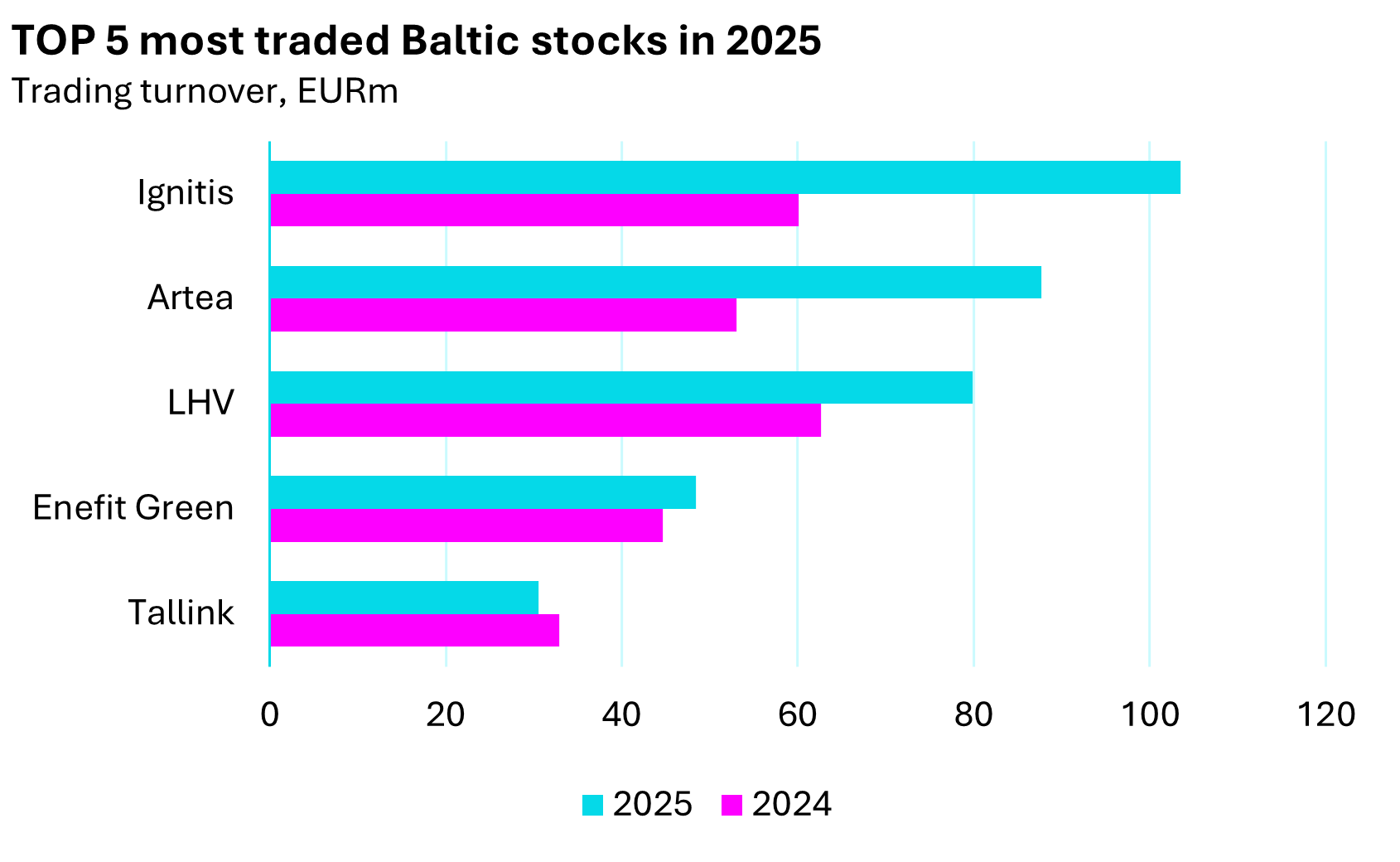
The list of the five most actively traded stocks remained unchanged from 2024, although the rankings shifted. Rising from second place, Ignitis became the most traded stock in the Baltic market, with turnover reaching €103m — a 72% increase year on year. The company’s share price rose by 8%. Artea climbed to second place, with turnover jumping 65% to €88m. Among the five most liquid stocks, the Lithuanian bank also recorded the strongest share price performance, gaining 14%. LHV, the most actively traded stock in 2024, slipped to third place despite a 27% increase in turnover to €80m. The Estonian bank’s shares rose by 10% in 2025. Delisted Enefit Green ranked fourth with €48m in turnover, while Tallink completed the top five, with turnover declining by 7% to €31m — the only stock in the group to see a year-on-year decrease in trading activity.
Primary market remains largely dormant
Despite the long-awaited recovery in the secondary market, the Baltic primary market remains effectively closed. Only three primary market transactions took place in 2025.
Estonian construction solutions company Primostar completed a €0.4m initial public offering, while Latvian financial services company Indexo raised €7.7m through two secondary public offerings. All three transactions were undersubscribed by investors.
Event of the year: the delisting of Enefit Green
At the beginning of 2025, few would have predicted that one of the largest and most liquid companies on the Baltic exchanges — and one that had gone public only a few years earlier — would leave from the market.
In March, Estonia’s state-owned energy group Eesti Energia announced a buyout of minority shareholders in renewable power producer Enefit Green. The offer price represented a 47% premium to the prevailing market price prior to the announcement.
The size of the premium was positively received by investors, particularly given that Baltic markets have become accustomed to seeing minority shareholders bought out at prices close to — or even below — prevailing market levels.
The timing also came as a surprise: just over three years had passed since Enefit Green’s IPO in October 2021. Investors who participated in the IPO and tendered their shares in the buyout realised a total return of 33%, including dividends paid over the three-year period.
The company was delisted from Nasdaq Tallinn in early July. While the buyout process was conducted transparently and at an attractive price, the transaction nevertheless represents a significant loss for the local capital market, which has been deprived of one of its largest and most liquid listed companies.